
Every importer who ships by sea hits the same question sooner or later: should this order go as a full container or share space with other shippers? The answer affects your freight bill, your delivery date, how often your cargo is handled, the risk of damage, how much inventory you carry and even how smoothly your goods clear Canadian customs. This guide explains LCL (less than container load) and FCL (full container load) in plain language, shows how each is priced, gives you a method for finding your own break-even point and covers what changes when the cargo is coming to Canada, including the move inland to Alberta.
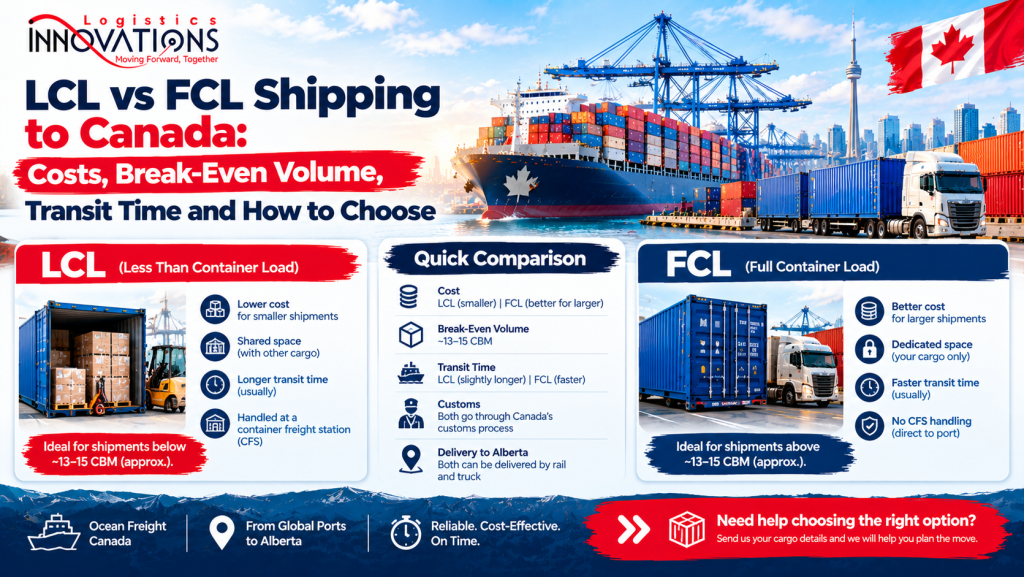
Quick answer: LCL is usually cheaper for small shipments, commonly under about 13 to 15 cubic metres (CBM), because you pay only for the space and weight your cargo uses. FCL is usually better above that volume, for heavy, fragile or high-value goods, and when you want fewer touches and a sealed door-to-door container. The 13 to 15 CBM figure is a rule of thumb, not a rule. Your lane, the freight market, your cargo density and the extra fees at each end can move the real break-even a long way, so always compare two complete quotes.
What LCL and FCL Mean
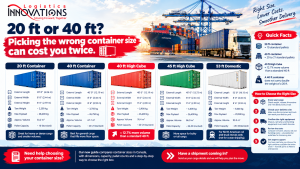
With FCL, you book an entire container, most often a 20 ft, 40 ft or 40 ft High Cube, and the price is for the container whether it is half empty or packed to the doors. Your goods are loaded at the supplier’s site or warehouse, the container is sealed, and it usually stays sealed until it reaches your own dock or the warehouse you chose. In practical terms, a 20 ft container offers roughly 28 CBM of usable space, a 40 ft container about 58 CBM and a 40 ft High Cube about 65 to 68 CBM for loose cargo. If you want exact dimensions and pallet counts, our guide to container sizes in Canada has the full tables.
With LCL, your cargo shares a container with goods from other shippers. A freight forwarder or non-vessel operating common carrier (NVOCC) collects shipments at an origin container freight station (CFS), which is a warehouse that receives, checks and loads cargo. The forwarder combines many small shipments into one container, which then sails like any other. At the destination port the container is taken to a CFS, opened and “deconsolidated”, and each consignee’s cargo is separated, checked and held until customs release and delivery are arranged. Each shipper has its own bill of lading and its own customs entry, so you are not mixed up with anyone else’s paperwork, even though you share the box.
One note on terms: LCL and FCL are ocean freight terms. If you are comparing trucking options inside Canada, the equivalent choice is full truckload against less than truckload, which we cover in FTL vs. LTL in Canada and LTL freight class in Canada.
How LCL Is Priced: The W/M Rule, Minimums and Add-On Charges
LCL is normally priced on a weight-or-measure (W/M) basis. The forwarder compares your cargo’s volume in cubic metres with its weight in metric tons, treats 1 CBM as equal to 1,000 kg, and bills whichever number is higher. Light, bulky cargo such as furniture or plastic products is therefore billed by volume, while dense, heavy cargo such as metal parts or tiles is billed by weight. Many forwarders set a minimum of 1 CBM, and some lanes accept 0.5 CBM. To calculate volume, multiply length by width by height in metres for every package or pallet and add them up. A standard pallet measuring 1.2 m by 1.0 m by 1.4 m, for example, is 1.68 CBM.
| Example cargo | Volume | Weight | Billed as |
|---|---|---|---|
| Light packaged goods | 6 CBM | 1,200 kg (1.2 t) | 6.0 W/M units (volume) |
| Dense metal parts | 2 CBM | 4,500 kg (4.5 t) | 4.5 W/M units (weight) |
| 10 pallets at 1.2 x 1.0 x 1.4 m | 16.8 CBM | 6,000 kg (6.0 t) | 16.8 W/M units (volume) |
The ocean rate is only one line on an LCL invoice. You should also expect an origin CFS charge for receiving, checking and loading your cargo, a destination CFS or deconsolidation charge, documentation fees, carrier surcharges such as fuel or peak-season adjustments, and the usual customs brokerage, duties and taxes. Under-declaring weight or volume to look cheaper is a mistake, because cargo is measured at the CFS and a mismatch leads to re-billing and delays. For FCL, the equivalent list is the flat ocean freight rate for the container, terminal handling and documentation, plus your own trucking, chassis, container return and any storage or demurrage if the box sits too long. Our guides to how much freight forwarders charge and drayage costs in Canada explain the cost lines that follow the vessel.
Where the Break-Even Point Sits
Because FCL is priced per container and LCL per cubic metre, there is a volume at which the two cost the same. Below it, LCL is cheaper. Above it, FCL is cheaper, and the gap widens quickly because every extra cubic metre you load into a container you already paid for is almost free until the box is full. Industry guides commonly place the break-even at about 13 to 15 CBM, which is roughly half of a 20 ft container, and they stress that this is a practical reference, not an official cutoff. When carriers compete hard for volume and FCL rates soften, the break-even can drop toward 8 to 10 CBM. When vessel space is tight and FCL rates climb, it can rise toward 20 to 25 CBM. Dense cargo also pulls the break-even down, because the weight charge makes LCL cost more than its CBM suggests.
The simplest way to find your own number is to divide the all-in FCL price by the all-in LCL price per W/M unit. The table below uses made-up prices only to show the method, and your own quotes will differ. It assumes a complete FCL price of $2,700 for a 20 ft container and a complete LCL price of $190 per W/M unit, which gives a break-even of about 14.2 units.
| Shipment size | LCL at $190 per unit | 20 ft FCL at $2,700 | Cheaper option |
|---|---|---|---|
| 8 units | $1,520 | $2,700 | LCL by $1,180 |
| 12 units | $2,280 | $2,700 | LCL by $420 |
| 14.2 units | $2,700 | $2,700 | Break-even |
| 16 units | $3,040 | $2,700 | FCL by $340 |
| 20 units | $3,800 | $2,700 | FCL by $1,100 |
Look at the 12 unit row: LCL is cheaper by $420, but the FCL option would give you the whole container for only a little more, with less handling and a faster, sealed journey. That is why the cheapest quote on paper is not always the best choice, and why you should compare time, risk and inventory needs next to price.
LCL vs FCL Side by Side
| Factor | LCL | FCL |
|---|---|---|
| Best volume | Roughly 1 to 15 CBM | About 13 to 15 CBM and above, or any heavy load |
| Pricing | Per W/M unit plus CFS and other fees | Per container, flat |
| Handling | Several touches at origin and destination CFS | Loaded once and sealed |
| Damage and loss risk | Higher, so packaging matters | Lower |
| Transit time | Ocean leg is the same, but CFS processing adds time at both ends | Usually faster door to door |
| Flexibility | Small, frequent orders, lower inventory | Larger, less frequent orders, more inventory |
| Customs and exams | Your cargo is separate, but a shared container can be affected by other cargo | You control what is in the box |
| Best for | New suppliers, test orders, mixed SKUs, small businesses | Regular volume, fragile or high-value goods, strict deadlines |
Transit time is the point that surprises most buyers. The ship takes the same number of days whether your goods are in an LCL or an FCL container, but LCL has to wait for the consolidator to collect enough cargo, load and close the container, and then wait again for deconsolidation at the destination CFS before your goods are available. Always ask for LCL transit times that include CFS processing at both ends, and build a buffer into your delivery plans. LCL cargo is also handled more often, which increases the chance of damage or minor loss. Use strong cartons, properly wrapped pallets or crates, and clear labels on every package that show the consignee and shipment reference. For fragile, high-value or sensitive products, FCL is usually the safer choice, and some goods, such as certain dangerous goods, may not be accepted for LCL consolidation at all, so confirm this with your forwarder before you book.
Not Sure Whether LCL or FCL Fits Your Shipment?
Send us your cargo size, weight, origin and delivery location, and the Innovations Logistics team will help you plan the move. Call (587) 315-9722, email info@innovationslogistics.com, or request a free quote.
How LCL and FCL Work When the Cargo Is Coming to Canada
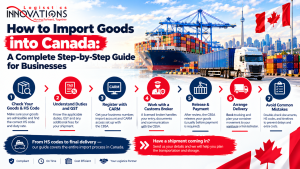
Whichever option you choose, imports into Canada follow the same customs rules. Commercial importers need a business number, an import program account and a CARM Client Portal account, and each shipment has to be reported, released, accounted for and paid for. With FCL, the container is one shipment under one declaration. With LCL, every consignee has its own bill of lading and its own entry, even though the cargo travelled in one box, so make sure the forwarder has your importer details, correct descriptions and accurate weights and volumes before the cargo leaves origin. Our step-by-step guide to importing goods into Canada, our article on CARM and our explanation of the importer of record cover these requirements in detail.
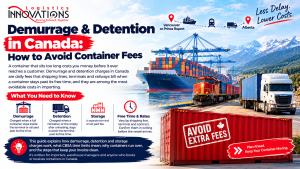
The CFS matters in Canada because deconsolidated cargo is usually held in a licensed warehouse under customs control until release. The CBSA describes sufferance warehouses as licensed facilities for the short-term storage and examination of imported goods held in bond, and its time limit for general goods is 40 days from the day they are reported, with shorter limits for perishables and certain regulated goods. Those limits are separate from the free time set by carriers and terminals, which is why a delayed pickup can still produce storage charges. If a shipment is selected for examination, the cost of handling it is usually charged by the shipping industry and passed on to the importer, and fees charged by authorized third parties to unload and reload goods are the importer’s responsibility. For the commercial side of delays, read our guide to demurrage and detention charges in Canada.
For importers in Alberta, the practical question is what happens after the cargo reaches a West Coast port. FCL containers can be picked up by a drayage truck or loaded on a train to an Alberta rail ramp and then delivered to your dock, as explained in our guide to shipping containers from Vancouver or Prince Rupert to Alberta. LCL cargo is normally deconsolidated at a CFS near the port and then moved on as a truck shipment, or, depending on the forwarder and on what customs allows, a sealed consolidated container can sometimes be moved inland under bond and opened closer to you. Ask your forwarder which approach they use, because it changes both cost and timing. Our page on bonded shipments and our guides to bonded shipping in Canada and what a bonded shipment is explain how inland movement works.
How to Choose Between LCL and FCL: Step by Step
Step 1: Measure and Weigh Your Cargo Accurately
Measure the packed dimensions of every carton or pallet, including packaging and pallets, and get the real gross weight from your supplier. Calculate total CBM and total tonnes, then compare them to find your W/M units. Use measurements from your supplier’s packing list, not estimates, because the CFS will measure the cargo again and bill against what it finds.
Step 2: Compare Against the Container Capacity
If your cargo is close to half a container or more, price a 20 ft FCL as well as LCL. If it is more than a full 20 ft container, compare a 40 ft or 40 ft High Cube with two smaller containers. Check weight limits as well as volume, since dense cargo can reach the weight limit before it fills the space.
Step 3: Get Complete Quotes for Both Options
Ask your forwarder to quote LCL and FCL on the same terms, including origin charges, ocean freight, surcharges, destination CFS or terminal fees, customs brokerage and delivery to your warehouse. Quotes that stop at the port are not comparable. Our guide to door-to-door freight forwarding explains what a complete quote should include.
Step 4: Weigh Time, Risk and Inventory, Not Just Price
Ask how long the cargo can wait, how fragile or valuable it is, and how much stock your warehouse and cash flow can handle. A full container may be cheaper per unit, but it also means ordering more stock at once, which ties up cash and storage space. LCL costs more per unit but lets you order smaller quantities more often, which can reduce inventory risk for new products or uncertain demand.
Step 5: Plan the Delivery and Storage
Decide who will pick up the cargo, where it will go and what happens if your warehouse is not ready. Arrange drayage for FCL before the vessel arrives, and think about warehousing and transloading if you want cargo broken down, stored and shipped in smaller loads. Our guides to transloading services in Canada and transloading vs. cross-docking show when each makes sense, and how much warehousing services cost in Canada helps you budget.
Step 6: Review and Re-Check Each Shipment
Your best choice can change from one order to the next. A shipment that was 10 CBM last quarter may be 17 CBM this quarter, and market rates move all the time. Re-run the comparison each time instead of defaulting to the same option.
Smart Ways to Save on Ocean Freight
If you buy from several suppliers in the same region, ask your forwarder about buyer’s consolidation, where goods from different suppliers are gathered at one CFS and shipped together as one FCL container under your name. This gives you the lower per-unit economics of a full container and one customs entry instead of several LCL shipments. You can also save by combining small orders so they cross the break-even point, by standardizing carton sizes so you use space efficiently, by packing pallets to the allowed height and by avoiding peak-season bookings when you can. Air freight can also make sense for very small, urgent or high-value cargo, and our guide to air vs. ocean freight explains the trade-offs. For wider cost control, read how to reduce logistics costs for import and export businesses in Canada.
Common LCL and FCL Mistakes to Avoid
The most expensive mistakes are usually planning mistakes. Importers compare only the ocean rate and ignore CFS fees, delivery and customs. They under-declare weight or volume and then pay re-measurement charges. They book LCL for dense cargo and are surprised by weight-based billing. They choose FCL for a half-empty container without comparing a smaller LCL option, or they overfill a container beyond the weight limit. They forget that a shared container can be held up when another shipper’s cargo is selected for examination. They leave pickup until the last minute, so the cargo sits in a warehouse or terminal and generates storage fees. And they use poor packaging for LCL, even though cargo is handled several times. Avoid all of these by measuring accurately, requesting complete quotes, preparing documents early and planning delivery before the cargo sails.
How Innovations Logistics Supports LCL and FCL Imports
Innovations Logistics supports importers with freight forwarding to coordinate the shipment, drayage to move containers from the port or rail ramp to your site, intermodal service that combines rail and trucking, bonded shipment support for cargo moving under customs control, warehousing and transloading to store, sort and redistribute freight, and container storage, rental and repair for extra space. Your licensed customs broker handles the customs filing, and we support the transportation and storage around it. If you are comparing providers, our articles on freight forwarder vs. freight broker and top freight forwarding companies in Canada can help, and once your cargo is moving you can track your shipment online.
Frequently Asked Questions
What is the difference between LCL and FCL?
FCL means you book a whole container for your cargo alone. LCL means your cargo shares a container with other shippers and you pay for the space and weight you use.
At what volume should I switch from LCL to FCL?
A common rule of thumb is about 13 to 15 CBM, but it varies with the lane, the freight market and your cargo density. Compare full quotes for both options instead of relying on one number.
How is LCL shipping priced?
Usually per weight-or-measure unit, where 1 CBM is treated as 1,000 kg and you are billed for whichever is higher, plus origin and destination CFS fees, documentation and surcharges.
Is LCL slower than FCL?
The ocean voyage takes the same time, but LCL adds time for consolidation at origin and deconsolidation at the destination CFS, so the total door-to-door time is usually longer.
Is LCL riskier for my cargo?
It involves more handling, so the risk of damage or loss is higher than in a sealed FCL container. Strong packaging, clear labels and marine cargo insurance help.
Do I need a separate customs entry for LCL cargo?
Yes. Each consignee in a consolidated container has its own bill of lading and its own customs declaration, so the importer details and paperwork must be correct for your shipment.
How do I get LCL cargo from a West Coast port to Alberta?
Usually the cargo is deconsolidated at a CFS near the port and then trucked to you, though some forwarders may be able to move a sealed consolidation inland under bond. Ask your forwarder which option applies.
Can I mix goods from several suppliers in one container?
Yes, through buyer’s consolidation, where a forwarder collects goods from multiple suppliers and ships them together as one FCL container.
Can dangerous goods ship as LCL?
Some can, but acceptance is limited and requirements are strict. Check with your forwarder before booking.
What if my warehouse is not ready when the cargo arrives?
You can use warehousing, transloading or container storage so cargo is not left in a terminal, which helps you avoid storage, demurrage and detention charges.
Plan Your Next Ocean Shipment With Us
Tell us what you are shipping, where it is coming from and where it needs to go, and our team will help you compare options and plan pickup, delivery and storage. Call (587) 315-9722, email info@innovationslogistics.com, or request a free quote today.