
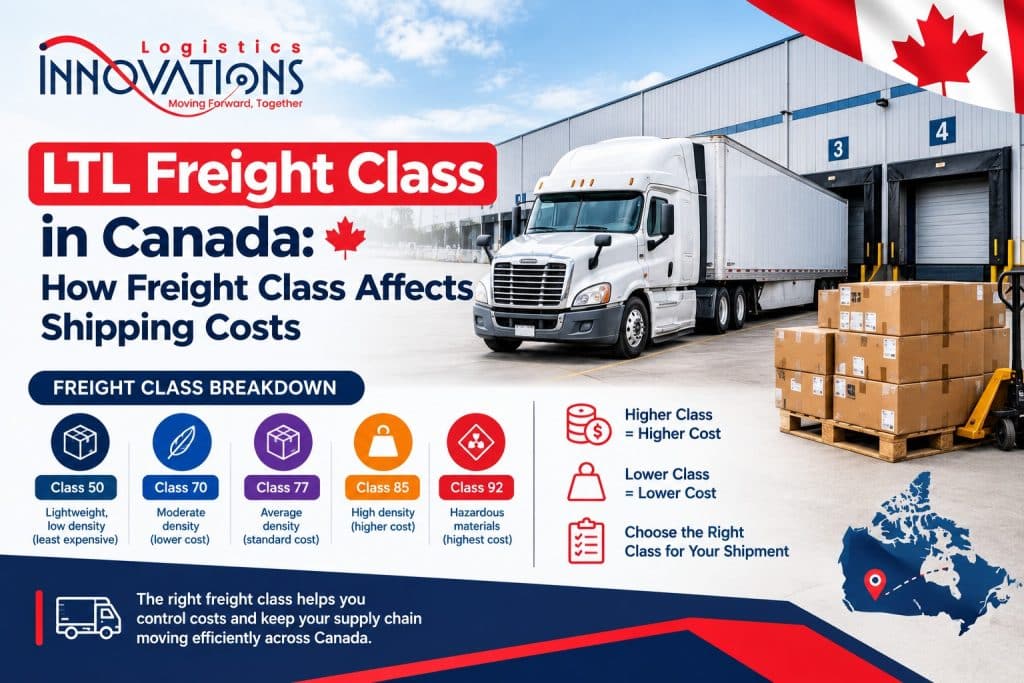
If your business ships pallets or other freight by less than truckload service, LTL freight class can have a major effect on what you pay. The class assigned to your shipment helps carriers determine the transportation rate based on factors such as density, handling, stowability, and liability.
For Canadian businesses, understanding LTL freight class in Canada is especially important when comparing quotes or shipping across provinces and the Canada and United States border. An incorrect class can lead to a reclassification, a higher final invoice, or delays in resolving the shipment.
The good news is that freight classification does not have to be complicated. Once you understand density, shipment measurements, and the other factors carriers consider, you can prepare more accurate LTL shipments and make better cost comparisons.
What Is LTL Freight Class?
LTL freight class is a classification system used to describe freight for less than truckload shipping. In the North American freight market, the National Motor Freight Classification, or NMFC, provides a widely used standard for classifying many types of LTL freight.
The current NMFC system uses freight classes from 50 to 500. In general, lower classes apply to denser and easier to transport freight, while higher classes apply to freight that is lighter, bulkier, harder to handle, or carries greater transportation risk.
For many commodities, density is now the main factor. However, density is not the only consideration. Handling, stowability, and liability can also affect the applicable class. This matters because freight class is one part of how an LTL carrier calculates your shipping rate.
How Does Freight Class Affect LTL Shipping Costs?
Higher freight class generally means a higher LTL transportation rate for the same weight and shipping lane. A dense shipment can use trailer space efficiently, while a lightweight shipment that occupies a large amount of space can be more expensive to transport.
For example, imagine two shipments that each weigh 500 pounds.
One shipment may be compact and dense, using relatively little trailer space. Another may be bulky and lightweight, occupying much more space. Even though both weigh the same, their freight classification and resulting transportation rates may be different.
Your final LTL price also depends on other factors, including:
- Shipment weight
- Shipment dimensions
- Pickup and delivery locations
- Freight class
- Fuel charges
- Accessorial services
- Carrier pricing
- Current capacity and lane conditions
So freight class is important, but it is not the only factor that determines the final invoice.
How Is LTL Freight Class Determined?
For many shipments, the starting point is freight density. Density measures how much a shipment weighs compared with the amount of space it occupies.
The basic formula is:
Density = Weight in pounds ÷ Volume in cubic feet
To calculate the volume of a pallet measured in inches:
Length × Width × Height ÷ 1,728 = Cubic feet
Then divide the shipment weight by the cubic feet.
Example of Freight Density
Suppose a pallet measures:
- Length: 48 inches
- Width: 40 inches
- Height: 48 inches
- Weight: 500 pounds
The volume is approximately 53.33 cubic feet.
The density is:
500 ÷ 53.33 = approximately 9.38 pounds per cubic foot
Under the current standard density scale, that falls into the 8 to less than 10 pounds per cubic foot range, which corresponds to Class 100 for density rated freight. The actual applicable class still depends on the commodity and its current NMFC provision. This is why accurate measurements matter so much when requesting an LTL quote.
Current Freight Class and Density Guide
For shipments that are rated using the standard density scale, the current 13 tier structure is:
Density in pounds per cubic foot | Freight class |
Less than 1 | 400 |
1 to less than 2 | 300 |
2 to less than 4 | 250 |
4 to less than 6 | 175 |
6 to less than 8 | 125 |
8 to less than 10 | 100 |
10 to less than 12 | 92.5 |
12 to less than 15 | 85 |
15 to less than 22.5 | 70 |
22.5 to less than 30 | 65 |
30 to less than 35 | 60 |
35 to less than 50 | 55 |
50 or more | 50 |
The 13 tier structure was introduced as part of the NMFC changes that took effect on July 19, 2025. NMFTA states that the changes expanded the density scale and moved more than 2,000 items toward density based classification.
However, do not assume that density alone determines the class for every shipment. Certain commodities can have provisions that account for special handling, stowability, or liability characteristics. The applicable NMFC item should be confirmed before booking.
The Four Main Factors Behind Freight Class
1. Density
Density measures the relationship between weight and space. Higher density generally results in a lower freight class. Lower density generally results in a higher class.
This is particularly important under the newer NMFC structure because density is now the primary classification factor for many commodities.
2. Stowability
Stowability refers to how easily freight can be loaded and positioned with other shipments. Freight that is unusually shaped, difficult to stack, or creates limitations for other cargo can have different classification considerations.
Good pallet preparation can therefore affect more than appearance. It can make the shipment easier to handle and position.
3. Handling
Some freight takes more time, equipment, or care to move.
Examples can include freight that is difficult to handle manually, fragile products, or shipments requiring special equipment. These characteristics can affect classification even when the density calculation suggests a particular class.
4. Liability
Liability relates to the potential risk of damage, loss, or damage to other freight. Fragile, high value, or damage sensitive products may have classification considerations that differ from ordinary dense freight.
Why the 2025 NMFC Changes Matter to Canadian Shippers
If you have been using the same freight class for years, it is worth checking whether it is still correct. The NMFC changes that took effect in July 2025 introduced a more detailed 13 tier density structure and moved thousands of items toward density based classification. NMFTA also notes that items with special handling, stowability, or liability concerns can still require different treatment.
This is important for freight class Canada searches because Canadian shippers can encounter different rating practices depending on the carrier, lane, and shipment. The NMFC is a US industry classification standard, but it is widely relevant to Canada and United States LTL movements. Canadian domestic carriers may also use their own tariffs or classification methods.
The safest approach is to use the classification method required by the carrier providing your quote rather than relying on an old class from a previous shipment.
How Incorrect Freight Class Can Increase Your Shipping Cost
One of the most common problems with LTL freight is entering inaccurate shipment information at booking.
For example, a business may provide a lower class because it was used on an older shipment. The carrier later measures the shipment and determines that the actual classification should be higher. The final invoice may then be adjusted.
Common causes include:
- Incorrect pallet dimensions
- Weight that does not include the pallet or packaging
- Incorrect commodity information
- An outdated freight class
- Unreported overhang
- Incorrect number of handling units
- Failure to account for special handling requirements
NMFTA guidance also states that density is generally calculated for each handling unit unless specific conditions allow another calculation method. Accurate information at the beginning helps reduce surprises after pickup.
How Canadian Businesses Can Reduce LTL Shipping Costs
You cannot simply choose a lower freight class to get a cheaper rate. The class must accurately represent the shipment. Instead, focus on improving the information and preparation behind your shipment.
1: Measure the Complete Handling Unit
Measure the pallet, skid, crate, or other handling unit after packaging. Include the full height and any overhang.
2: Weigh the Shipment Correctly
Use the actual shipping weight, including packaging and the pallet where applicable. A small difference in weight can change the calculated density.
3: Improve Packaging
Use packaging that protects the product without creating unnecessary space. Tighter palletization can reduce wasted cube and may improve density.
4: Confirm the Commodity
Do not select a freight class simply because it appeared on an old bill of lading. Confirm the current classification requirements for the actual commodity being shipped.
5: Provide Complete Information to Your Logistics Provider
When requesting an LTL quote, provide:
- Pickup location
- Delivery location
- Number of pallets or handling units
- Length, width, and height
- Total weight
- Product description
- Applicable freight class or classification information
- Any special handling requirements
- Delivery requirements
This gives the carrier or logistics provider enough information to build a more accurate quote.
Freight Class Is Only One Part of Your LTL Rate
A common mistake is to compare two LTL quotes based only on freight class. Your total shipping cost can also be affected by the route, weight, fuel charges, delivery requirements, and accessorial services.
For example, a shipment may require:
- Liftgate service
- Residential delivery
- Inside delivery
- Appointment delivery
- Limited access delivery
- Special handling
These charges can change the final amount even when the freight class is identical. This is why Canadian businesses should compare the complete quoted cost rather than focusing only on the base transportation rate.
When Should You Use LTL Shipping?
LTL is commonly used when a shipment does not require an entire truck. It can be suitable for businesses shipping smaller quantities of palletized freight between Canadian cities or across the Canada and United States border.
If you regularly ship only a few pallets, LTL can avoid the cost of booking an entire truck. If your shipment volume becomes large enough, however, it can be useful to compare LTL with full truckload service.
Innovations Logistics already covers both LTL and full truckload transportation as part of its logistics services. For businesses that need help coordinating different transportation options, freight forwarding services can also provide carrier coordination, shipment planning, tracking, and documentation support.
Frequently Asked Questions
1. What is LTL freight class?
LTL freight class is a classification used to determine how freight is rated for less than truckload transportation. It considers characteristics such as density, handling, stowability, and liability.
2. Does a higher freight class cost more?
Generally, yes. For the same shipment weight and lane, higher freight classes usually have higher transportation rates because the freight may take up more space or require additional handling or risk management.
3. How do I calculate LTL freight density?
Multiply the shipment length, width, and height to calculate its volume. Convert the volume to cubic feet, then divide the shipment weight in pounds by the cubic feet. The result is density in pounds per cubic foot.
4. Can the freight class I used before become outdated?
Yes. NMFC classification rules can change, and major changes took effect in 2025. If you have not reviewed your commonly shipped products since those changes, confirm the current classification before using an old class again.
5. What information do I need for an LTL freight quote?
You should normally provide the pickup and delivery locations, number of handling units, dimensions, total weight, product description, freight class or applicable classification information, and any special pickup or delivery requirements.
Conclusion: Get Your LTL Freight Class Right
LTL freight class in Canada can directly affect the rate you pay for moving palletized freight. Density is now the main classification factor for many commodities, but handling, stowability, liability, commodity rules, and carrier requirements can also matter.
The best way to avoid unexpected charges is to measure and weigh your freight accurately, use current classification information, and provide complete shipment details before booking.
If your business regularly ships LTL freight across Canada or between Canada and the United States, Innovations Logistics can help coordinate transportation and carrier selection based on your shipment requirements. Our team has more than 10 years of logistics experience and supports businesses with LTL, freight forwarding, warehousing, drayage, and other transportation solutions.
For help planning your next shipment, contact Innovations Logistics with your freight dimensions, weight, pickup location, delivery location, and cargo details so we can help you determine the right shipping solution.