
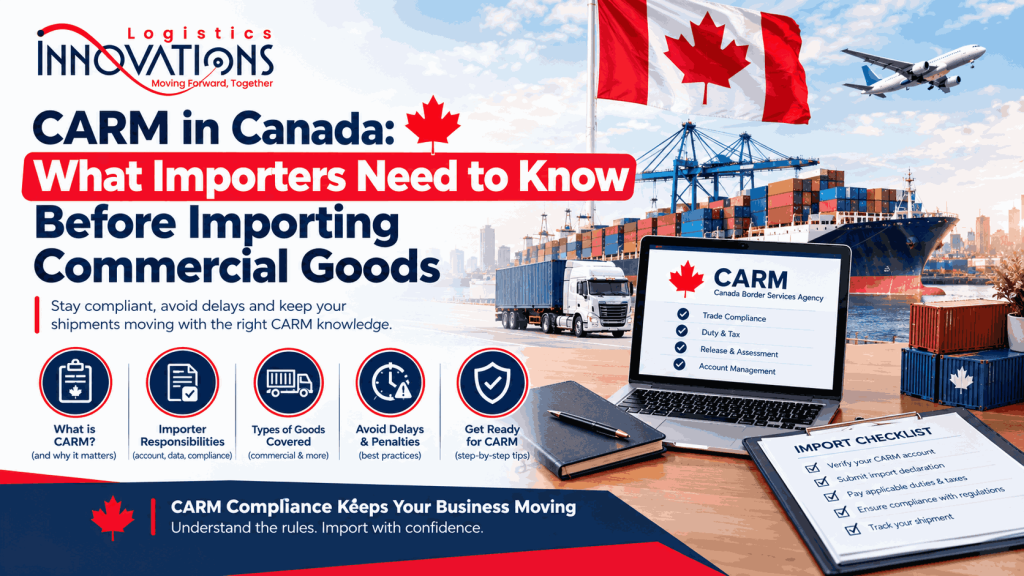
CARM in Canada is the CBSA system used to assess and collect duties and taxes on commercial goods. If your business imports, you need your own CARM Client Portal account. Without it, your shipments can be delayed, returned, or hit with late accounting penalties.
This guide explains what CARM is, who needs an account, how to register, and what to sort out before your next shipment.
What Is CARM in Canada?
CARM stands for CBSA Assessment and Revenue Management. It is the official system of record for duties and taxes on commercial goods imported into Canada.
Importers use the CARM Client Portal to:
- File and correct accounting declarations
- View duties, taxes and monthly statements
- Make payments
- Give a customs broker authority to act for them.
The Commercial Accounting Declaration (CAD) now replaces older paper style forms such as the B3. In plain terms, CARM shifts more accounting and financial responsibility to the importer.
Who Needs a CARM Account?
Any business that imports commercial goods into Canada needs one. Size does not matter. You need an account if your business:
- Imports once a year or in small amounts
- Ships goods through a courier
- Uses a customs broker or other third party to clear goods
- Imports goods to sell, use, or bring in temporarily
- Is based outside Canada but imports as the importer of record.
Importers must register their own business. A customs broker cannot do it for you. Since January 1, 2026, a broker’s business number can no longer be used to release or account for your goods. Your own account has to be in place.
What Are a BN9 and an RM Account?
You need two numbers before you can use CARM properly.
BN9: This is a 9 digit business number issued by the Canada Revenue Agency. Most new Canadian businesses can get one during portal registration. Nonresident businesses must get theirs from the CRA first, or registration will fail.
RM account: This is your import/export program account, a 6 digit number such as RM0001. If you do not have one, you can enrol for it while registering in the portal.
How to Register for CARM
- Confirm you have a BN9, or get one from the CRA if you are a nonresident or an unusual entity type.
- Create your user profile in the CARM Client Portal.
- Select “Register my business” on the first time setup page.
- Enter your RM number, or enrol in the importer program.
- Review your delegation of authority if you use a broker.
- Add a second business account manager as a backup.
The first person to register becomes the business account manager. That person approves employee access, so choose carefully and never leave the role with one person only.
How Does CARM Work for Commercial Importers?
The process follows a simple pattern:
- Your goods are shipped and cleared, either by you or by your authorized broker.
- A CAD reports the goods, their value, origin, and classification.
- CARM calculates duties and taxes.
- You receive a monthly Statement of Account.
- You pay by the due date shown in the portal.
Late payments now carry penalties and interest. The CBSA’s transition period that waived them ended on January 31, 2026, so paying on time matters.
What Is Release Before Payment (RPP)?
Release Before Payment lets your goods move before you pay duties and taxes. To use it, you post your own financial security in the portal. Your broker’s security no longer covers you.
You have two main options:
- Cash deposit: 100% of your highest monthly amount owing to the CBSA in the past 12 months
- Surety bond: At least 50% of that same figure
The required amount shows in your portal. Here is a simple example. If your busiest month in the past year came to $40,000 in duties and taxes, a cash deposit would be $40,000 and a bond would need to cover at least $20,000. A bond has an annual cost, while a cash deposit ties up money you could use elsewhere.
If you skip RPP, you must pay in advance through the portal before goods are released. That slows down time sensitive freight.
Do You Need a Customs Broker With CARM?
Many importers still choose a licensed customs broker because classification, valuation, and filing take experience. CARM does not remove that need. It changes how the relationship works.
If you use a broker, you must delegate authority to them inside the portal. The broker also needs a business relationship request sent through their own portal account. Without this link, the broker cannot act on your behalf.
Delegating filing work does not delegate responsibility. You are still accountable for what is declared and paid.
What Importers Are Responsible For
Under CARM, importers remain responsible for:
- The accuracy of value, origin, and tariff classification
- Paying statements on time
- Keeping RPP security at the right level
- Managing who can access the portal
- Keeping supplier and shipping records that support each declaration
Common CARM Mistakes Importers Should Avoid
- Assuming the broker handles everything. Your account and delegation must exist first.
- Registering late. Goods can be held at the border while you sort it out.
- Relying on one portal user. If that person leaves, access becomes a problem.
- Ignoring your security level. Rising import volumes can push you past your posted amount.
- Missing the payment date. Penalties and interest can follow.
- Sending unclear commercial documents. Weak invoices lead to slow, costly corrections.
CARM Checklist Before Importing Commercial Goods
- Confirm your BN9 and RM account.
- Register in the CARM Client Portal
- Assign a backup business account manager.
- Decide whether to enrol in RPP.
- Post the right cash deposit or bond.
- Delegate authority to your customs broker
- Set a payment routine for your monthly statement.
- Line up your freight, bonded movement and delivery plan.
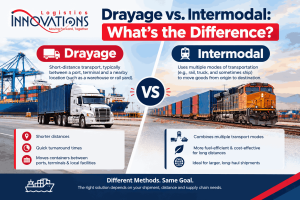
That last step is often overlooked. Clearing customs is only one part of the trip. Your goods still need to reach a warehouse or your customer on time. If your freight needs to travel under customs control, ask about bonded shipment options. If containers arrive at a port or rail yard, plan the drayage service early so trucks and delivery windows line up with your release.
Frequently Asked Questions About CARM
What does CARM stand for in Canada?
CARM stands for CBSA Assessment and Revenue Management. It is the CBSA system for assessing and collecting duties and taxes on commercial goods imported into Canada.
Is CARM mandatory for all importers?
It applies to businesses importing commercial goods into Canada, including nonresident importers. Registration in the CARM Client Portal is required to continue importing without disruption.
Can my customs broker register me for CARM?
No. Importers must register their own business. Once registered, you can delegate authority to your broker in the portal.
Do I have to join the RPP program?
No, but without it you must pay duties and taxes before goods are released. RPP requires you to post your own financial security, either a cash deposit or a bond.
What happens if I import without a CARM account?
Your shipment may be delayed or returned, and late accounting penalties may apply. It is much easier to register before your goods are on the way.
Conclusion
CARM has made importing more direct. You register, you post security if you want RPP, you delegate to your broker, and you pay your statement on time. Businesses that treat it as a checklist rather than a last minute fix have fewer delays and fewer surprises.
Getting your account ready is one half of a smooth import. The other half is moving the freight well. If you are planning a commercial import, talk to our team about freight forwarding, warehousing and transloading, and delivery from port to door. Contact Innovations Logistics for a quote.