
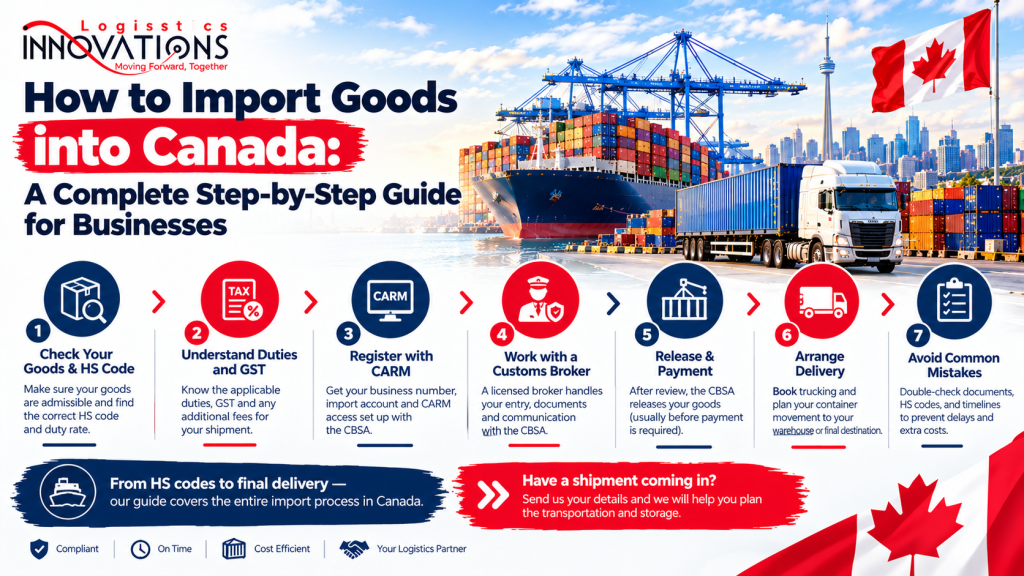
Importing goods into Canada is a series of connected steps, and a mistake at the start can cause delays, fees or penalties at the end. You need to know what your goods are, where they come from, what duties and taxes apply, how your business is registered with the Canada Border Services Agency (CBSA), and how your cargo will be reported, released and paid for when it arrives. Then you still need to move it from the port or border to your warehouse.
This guide walks through the full process for businesses importing commercial goods into Canada, from your first classification question to the day your container is delivered. It is based on the CBSA’s official import guidance, updated in September 2026. Rules, rates and trade measures change, so always confirm the details for your own goods with the CBSA or a licensed customs broker before you ship.
Quick answer: To import commercial goods into Canada, you must confirm your goods are admissible, find their country of origin and tariff classification (HS code), work out the value for duty, and estimate duties and taxes. Your business then needs a business number, an import program account and a CARM Client Portal account. You report the shipment through your carrier, have the goods released (most commonly by enrolling in Release Prior to Payment and posting financial security), and pay duties and taxes by the due date. Many importers hire a licensed customs broker to handle the filing.
Who This Guide Is For
This guide is for businesses that import commercial goods, meaning goods that will be sold, or used for business, industrial, commercial or similar purposes. The CBSA’s CARM program affects all commercial importers, whether you bring in one shipment a year or hundreds. Individuals importing casual, non-commercial goods that are not for sale or business use are not subject to the same CARM requirements.
If you already know your goods are commercial, the next question is who will be the importer of record. That is the party identified on the customs declaration when the goods are released and accounted for. Read our guide to importer of record in Canada: duties, risks and costs before you decide.
The Import Process at a Glance
| Stage | What happens | Who usually handles it |
|---|---|---|
| 1. Research | Confirm admissibility, origin, HS code, duty rate and value for duty | Importer, with broker or forwarder |
| 2. Registration | Business number, import program account, CARM Client Portal, financial security | Importer |
| 3. Shipping | Order goods, choose mode and port of entry, give accurate cargo data to the carrier | Importer, forwarder and carrier |
| 4. Reporting | Carrier reports the cargo to the CBSA before arrival (ACI or eManifest) | Carrier |
| 5. Release and accounting | Submit the commercial accounting declaration (CAD) and obtain release | Importer or customs broker |
| 6. Payment | Pay duties and taxes by the due date | Importer or customs broker |
| 7. Delivery | Pick up and deliver the cargo, unload and return empty equipment | Drayage or trucking provider |
| 8. After release | Keep records, correct errors, respond to CBSA questions | Importer |
Planning Your First Import?
Talk to the Innovations Logistics team about transportation, storage and delivery for your shipment. Call (587) 315-9722, email info@innovationslogistics.com, or request a free quote.
Before You Ship: Research and Setup
Step 1: Confirm Your Goods Are Admissible
Start by checking whether your goods are controlled, regulated or prohibited by the CBSA or another government department or agency. Some products need permits, licences or certificates before they can enter Canada, and others cannot be imported at all. Do this before you place an order, because goods that arrive without the right documents can be held, refused or seized.
Step 2: Determine the Country of Origin
The country of origin is where the goods were produced or manufactured under customs rules, which is not always the country you ship from. Origin decides which tariff treatment applies, so it directly affects how much duty you pay. Keep supplier documents that prove origin, because the CBSA can ask for them.
Step 3: Classify Your Goods With an HS Code
Every product has a tariff classification number, also called an HS code. The first six digits are an international identifier used by most trading countries, and the next four digits are specific to Canada and set the duty rate and statistics. The CBSA gives this example of how a 10-digit number breaks down:
| Part of the code | Example | Meaning |
|---|---|---|
| Heading (international) | 9507 | First four digits |
| Sub-heading (international) | 9507.90 | First six digits |
| Tariff item (Canadian) | 9507.90.10 | Eight digits |
| Statistical suffix (Canadian) | 9507.90.10.00 | Full 10-digit number |
You can use the classification tool in the CARM Client Portal, the Canadian Customs Tariff, or request an advance ruling from the CBSA for certainty. An advance ruling assigns a 10-digit tariff classification number to your goods and is legally binding between the CBSA and the person who receives it. Wrong classification is one of the most common causes of incorrect duty payments, so take this step seriously.
Step 4: Check the Tariff Treatment and Duty Rate
Once you have the HS code and country of origin, find the tariff treatment that applies. Most-Favoured-Nation (MFN) rates apply to goods from most countries. Reduced preferential rates can apply if your goods qualify under a trade agreement such as CUSMA, the Canada-European Union agreement (CETA), CPTPP, or others. To claim a preferential rate, you must have proof of origin on hand and meet any shipping requirements, such as direct shipment. For example, claiming the United States tariff under CUSMA requires a valid CUSMA certification of origin and direct shipment from the United States to Canada.
Step 5: Work Out the Value for Duty
The value for duty is the value of your goods used to calculate duties and taxes. The CBSA lists six valuation methods, and you start with the first and move to the next only if you cannot use it. In most cases, the value is based on the price you paid the seller, adjusted for certain costs. To support your declared value, you need an invoice or sales receipt that includes:
- A complete description of the goods
- The selling price
- Any conditions and terms of the sale
You must declare value for duty in Canadian dollars. Convert your invoice using the exchange rate from the date the goods began their direct and uninterrupted journey to Canada. Even when no duty is owed, the value for duty is still used to calculate any taxes that apply.
Step 6: Estimate Duties and Taxes
Commercial imports can be subject to several charges. The CBSA describes these main types:
| Charge | What it is |
|---|---|
| Customs duty | A tax on imported goods, based on tariff classification and treatment |
| Excise duty and excise tax | Charges on certain goods such as alcohol, tobacco and some vehicles and fuels |
| GST | A federal tax on most imported goods, calculated on the value plus any duty |
| Surtax | An additional temporary tax set by an Order in Council, charged on top of customs duties |
| Safeguard | A temporary measure protecting a Canadian industry from a sudden surge in imports |
When news reports mention a “tariff” in the current trade environment, they usually mean a surtax. Surtaxes and safeguards change, so check the CBSA’s customs notices before every shipment instead of relying on last quarter’s information.
A Worked Example of Duty and GST
This example uses made-up numbers to show the order of the calculation. It is not a rate for any real product. Assume an invoice of US$10,000, an exchange rate of 1.37, a 5% customs duty and 5% GST.
| Step | Calculation | Result (CAD) |
|---|---|---|
| Value for duty | 10,000 x 1.37 | $13,700.00 |
| Customs duty | 13,700 x 5% | $685.00 |
| Value for tax | 13,700 + 685 | $14,385.00 |
| GST | 14,385 x 5% | $719.25 |
| Total duty and GST | 685.00 + 719.25 | $1,404.25 |
The CARM Client Portal has a duties and taxes calculator you can use to estimate the amount before you ship. The result is an estimate because the final amount is based on the exchange rate for the shipping date. Some goods, such as prescription drugs, medical devices and basic groceries, are exempt from tax, and the correct exemption code must be entered on the declaration.
Step 7: Register With the CBSA
All commercial importers need three things to import goods into Canada:
- An account in the CARM Client Portal (CCP)
- A nine-digit business number (BN9)
- A six-character import program (RM) account, such as RM0001, which combines with your BN9 to create a 15-character importer number (BN15)
Canadian resident businesses can register for a business number through the portal. Non-resident importers must contact the Canada Revenue Agency for their business number first, then register in CARM and enrol in the importer program. Inside the portal, you can assign roles to your team: a business account manager with full access, a program account manager for specific accounts, an editor for operations such as payments and rulings, and a reader with view-only access. Naming at least two business account managers is recommended so you are never locked out. For more background, read our guide to CARM in Canada: what importers need to know.
Step 8: Decide Whether to Hire a Licensed Customs Broker
You can prepare and submit your own release and accounting documents, or you can hire a customs broker licensed by the CBSA. Brokers do not work for the government, and the CBSA does not regulate their fees, so agree on pricing before you hire one. Typical services include preparing and submitting documents to the CBSA, paying duties and taxes on your behalf if applicable, maintaining records and answering CBSA questions after payment.
To work with a broker, you sign a general agency agreement, delegate authority to them in the CARM Client Portal and, ideally, enrol in Release Prior to Payment. Remember that the importer listed when the goods are accounted for is responsible for paying duties and taxes and for post-accounting obligations such as record keeping and corrections. Hiring a broker does not remove that responsibility.
Step 9: Enrol in Release Prior to Payment and Post Financial Security
Release Prior to Payment (RPP) lets you have your goods released before you pay duties and taxes, and it is the most common release method for commercial importers. To qualify, you must enrol in the RPP sub-program in the CARM Client Portal, provide the financial security amount calculated by the system, account for goods within the required timeframes and pay all duties and taxes in full by the payment due date. Financial security can be provided through a surety bond or a cash deposit. Since CARM Release 3, a customs broker’s own financial security no longer covers commercial importers, so you need your own, even if you use a broker.
Shipping Your Goods to Canada
Step 10: Choose a Shipping Mode and Port of Entry
You can ship by highway, marine, rail, air, postal service or courier. If you hire a customs broker or freight forwarder, they may arrange the transportation as part of their services. Most shipments are released at the CBSA office where they first arrive in Canada. If you use a bonded carrier, you may be able to choose an inland warehouse closer to your location instead. Read our guides to bonded shipping in Canada and what a bonded shipment is to see when this option makes sense, and air versus ocean freight to compare modes.
Step 11: Give Your Carrier Accurate Cargo Data
If a carrier transports your goods, the carrier is responsible for submitting Advance Commercial Information (ACI) or eManifest data to the CBSA within the required timeframes before arrival. As the importer, you must give the carrier detailed and accurate cargo information so the goods can be reported correctly. Goods that are not reported correctly can face delays at the border.
Step 12: Mark and Label the Goods Properly
Goods and packaging must be marked and labelled according to Canadian requirements, including country of origin marking where it applies. Check the rules for your product category before the cargo leaves the factory, because relabelling after arrival can add cost and delay.
When Your Goods Arrive: Release, Accounting and Payment
Step 13: The Goods Are Reported on Arrival
All commercial goods must be reported to the CBSA without delay after they arrive. If a carrier moves your goods, the carrier usually notifies you of arrival. Overseas marine containers must first report at a designated first port of arrival, where they are screened, before they continue to their destination. If you are importing through a port that then connects to rail, our guide to shipping containers from Vancouver or Prince Rupert to Alberta shows how the inland leg works.
Step 14: Obtain Release
There are two ways to get your goods released and accounted for, and in both cases you or your customs broker submit the details through the CARM system, including the description, value, country of origin and tariff classification. The CBSA assigns each shipment a 14-digit transaction number to track it through release.
| Option | How it works | Best for |
|---|---|---|
| Option 1: Release before payment (RPP) | Goods are released first. You then account for them and pay duties and taxes by the due date | Regular commercial importers |
| Option 2: Release after full accounting and payment | You complete a paper Type C commercial accounting declaration, bring it with your documents to a CBSA office, and pay at the time of release | Importers not enrolled in RPP, or occasional shipments |
For Option 2, the CBSA lists the documents to bring: two copies of the cargo control document (form A8A-B) provided by your carrier, two copies of the Canada Customs Invoice (form CI1) or a commercial invoice with the same information, and paper copies of any permits, certificates or licences required by other departments.
Step 15: Pay Duties and Taxes
Importers with financial security in place must pay their account balance in full by the payment due date for each payment period. Importers without financial security must pay at the time the goods are released. If you pay at a CBSA office, the accepted methods include:
- Debit card: Visa Debit, Debit MasterCard or debit cards from Canadian financial institutions, with no payment limit set by the CBSA
- Credit card: Visa, MasterCard or American Express, with a limit of $4,999.99 per program account per billing cycle
- Cheque: payable to the Receiver General for Canada, and certified if it is over $5,000 unless you have active financial security in your CARM account
Step 16: Be Ready for Holds and Examinations
The CBSA or other government departments may hold or examine a shipment to check that it is admissible, that the description, value, quantity and markings match your invoice, and that other agency requirements are met. The costs of processing a shipment for examination are usually charged by the shipping industry and passed on to the importer, and fees charged by authorized third parties to unload and reload goods are your responsibility. If goods are found inadmissible, the CBSA can refuse entry or seize them, and non-compliance can lead to penalties under the Administrative Monetary Penalty System.
Delays at this stage also affect container fees. See our guide to demurrage and detention charges in Canada to understand how free time and storage clocks keep running during a hold.
Step 17: Deliver the Goods and Return the Equipment
After release, the container must be picked up, delivered and unloaded, and the empty equipment returned on time. Plan this before the vessel arrives. Our guides to shipping containers from port to warehouse, what drayage is and container sizes in Canada help you choose equipment and avoid delays.
Step 18: Keep Records and Correct Errors
After accounting, you remain responsible for keeping records, correcting mistakes and answering CBSA verification questions. If you find an error in the classification, value or origin you declared, correct it as soon as you can. Importers are generally required to keep import records for six years, so confirm the retention rules that apply to your business.
Import Documents Checklist
| Document | Why you need it |
|---|---|
| Commercial invoice or Canada Customs Invoice (CI1) | Shows description, price and terms of sale, and supports the value for duty |
| Bill of lading or air waybill | Proves the contract of carriage and identifies the consignee |
| Packing list | Matches quantities and packaging to the invoice |
| Proof of origin or certificate of origin | Required to claim preferential tariff treatment |
| Permits, licences or certificates | Required for controlled or regulated goods |
| Cargo control document (A8A-B) | Provided by the carrier, needed for paper release at a CBSA office |
| Commercial accounting declaration (CAD) | Accounts for the goods and calculates duties and taxes |
| General agency agreement and delegation | Authorizes your customs broker to act for you |
| Financial security (bond or cash deposit) | Needed for Release Prior to Payment |
What Does It Cost to Import Goods Into Canada?
Duties and taxes are only part of the cost. When you plan your landed cost, include each of the following:
- Product cost and supplier charges, including packaging and any export fees
- International freight by ocean, air, rail or road. See how much freight forwarders charge
- Insurance for the shipment
- Customs duties, surtaxes and GST on the value for duty
- Customs broker fees, which the CBSA does not regulate
- Financial security costs for a surety bond or cash deposit
- Port, terminal and examination charges, including unloading and reloading fees if your shipment is examined
- Drayage and inland transportation. See drayage costs in Canada
- Warehousing and storage. See how much warehousing services cost in Canada
- Demurrage, detention and storage fees if containers are not moved on time
To reduce the total, read how to reduce logistics costs for import and export businesses in Canada.
Special Cases to Know About
Courier and Postal Imports
For goods shipped by courier or mail, what happens next depends on the value. For shipments valued at CAN$3,300 or less, Canada Post delivers postal shipments, collecting any amount owing, and the courier notifies you of courier arrivals. Couriers cannot complete the commercial accounting declaration for commercial importers, so the importer or a customs broker must submit it. For postal shipments above CAN$3,300, you must submit a declaration through the CARM Client Portal, and if the mail centre does not receive release confirmation within 30 days of the notification letter, the goods are returned to the sender.
Non-Resident Importers
A business outside Canada can import goods as a non-resident importer, but it must first get a business number from the Canada Revenue Agency and then register in CARM and enrol in the importer program. This is a good place to get professional advice before you ship.
Bonded Movements Inland
A bonded carrier can move eligible goods from the port of arrival to an inland location under customs control before release. This can help importers who want cargo to leave a busy port quickly. Learn more about our bonded shipment service and read how to choose a bonded carrier in Canada.
Duty Deferral Programs
The CBSA offers programs that allow businesses to defer duties and most taxes on imported goods that will later be exported, whether or not the goods are further manufactured in Canada. If this applies to your business, ask your broker or the CBSA which program fits.
Goods Needing Permits
Food, plants, animal products, health products, firearms and many other goods are regulated by other departments. Always confirm permit requirements before you buy.
Timeline: What to Do and When
| When | What to do |
|---|---|
| Before you place the order | Check admissibility and permits, confirm origin and HS code, estimate duties and taxes |
| Before the goods ship | Register in CARM, get your BN15, choose a broker, delegate authority, enrol in RPP and post financial security, mark and label goods |
| While the goods are in transit | Send complete documents to your broker, book drayage and confirm your delivery appointment, confirm the last free day |
| On arrival | Confirm the carrier has reported the cargo, submit the declaration, obtain release |
| After release | Collect and deliver the container, unload it, return the empty, pay duties and taxes by the due date |
| Afterward | Save records, correct any errors and review landed costs |
Common Import Mistakes That Cause Delays or Penalties
- Not registering in CARM early enough. Without the right accounts and financial security, shipments can be delayed even when everything else is ready.
- Misclassifying goods. The wrong HS code leads to the wrong duty and possible penalties.
- Weak invoices. Missing descriptions, prices or terms of sale make it hard to support your value for duty.
- Assuming a trade agreement applies automatically. You need proof of origin and must meet shipping conditions to claim a reduced rate.
- Forgetting surtaxes and trade measures. These change often, so check current CBSA notices.
- Not telling the carrier everything. Incomplete cargo data can delay reporting at the border.
- Leaving transportation until the last minute. A container that clears customs still needs a truck, a chassis and an appointment.
- Ignoring container free time. Release delays and late pickup can add storage, demurrage and detention.
- Assuming the broker handles everything. The importer of record stays responsible for duties, records and corrections.
How Innovations Logistics Supports Importers
Your licensed customs broker handles the customs filing. Innovations Logistics supports the transportation and storage that surround it, with freight forwarding, drayage, intermodal service, bonded shipment support, warehousing and transloading, and container storage, rental and repair. Planning these together reduces gaps between customs release, pickup, delivery and storage. To understand what a forwarder manages, read door to door freight forwarding, freight forwarder vs. freight broker and our list of top freight forwarding companies in Canada and how to choose. Once your cargo is moving, you can track your shipment online.
Frequently Asked Questions
Do I need a business number to import goods into Canada?
Yes. Commercial importers need a nine-digit business number, an import program account and a CARM Client Portal account to transact directly with the CBSA.
What is a BN15?
It is your nine-digit business number combined with a six-character import program account number, such as RM0001. It identifies your importer account.
Do I need a customs broker to import into Canada?
No, you can prepare and submit your own documents. Many businesses hire a licensed customs broker for support. You are still responsible for duties, records and corrections as the importer of record.
What is Release Prior to Payment?
It is a CBSA sub-program that lets enrolled importers have goods released before they pay duties and taxes, provided they post financial security and pay by the due date.
What is an HS code?
It is the tariff classification number that identifies your product for customs purposes. In Canada it has 10 digits: six international and four specific to Canada.
How is GST calculated on imports?
GST is calculated on the value for duty plus any customs duty and other applicable charges. Some goods are exempt, and the correct exemption code must be entered on the declaration.
What is value for duty?
It is the value of the goods used to calculate duty and tax, usually based on the price paid to the seller and declared in Canadian dollars.
Can I claim a lower duty rate under a trade agreement?
Possibly. You need to meet the origin rules, have proof of origin and meet any shipping requirements for that agreement.
What happens if my goods are held at the border?
The CBSA or another agency may examine them to confirm they are admissible and match your invoice. If everything is in order, they can be released. If not, they can be refused or seized, and penalties can apply.
Can I pay duties by credit card?
At a CBSA office, credit cards are accepted up to $4,999.99 per program account per billing cycle. Debit cards and cheques are also accepted, subject to the CBSA’s rules.
Is importing by courier different?
Yes. For shipments valued at CAN$3,300 or less, the courier or Canada Post handles notification and collection, but couriers cannot complete the commercial accounting declaration for commercial importers.
How early should I plan transportation?
Before the vessel or flight arrives. Book your truck, confirm your delivery appointment and know your last free day so the container does not sit.
Get Your Cargo From Port to Warehouse Without Delays
Tell us your port, cargo details and delivery location, and our team will help you plan pickup, delivery and storage. Call (587) 315-9722, email info@innovationslogistics.com, or request a free quote today.
Information in this guide was reviewed in October 2026 against CBSA guidance. Rules, duty rates, surtaxes and thresholds can change, so confirm the requirements for your goods with the CBSA or a licensed customs broker before you ship.