

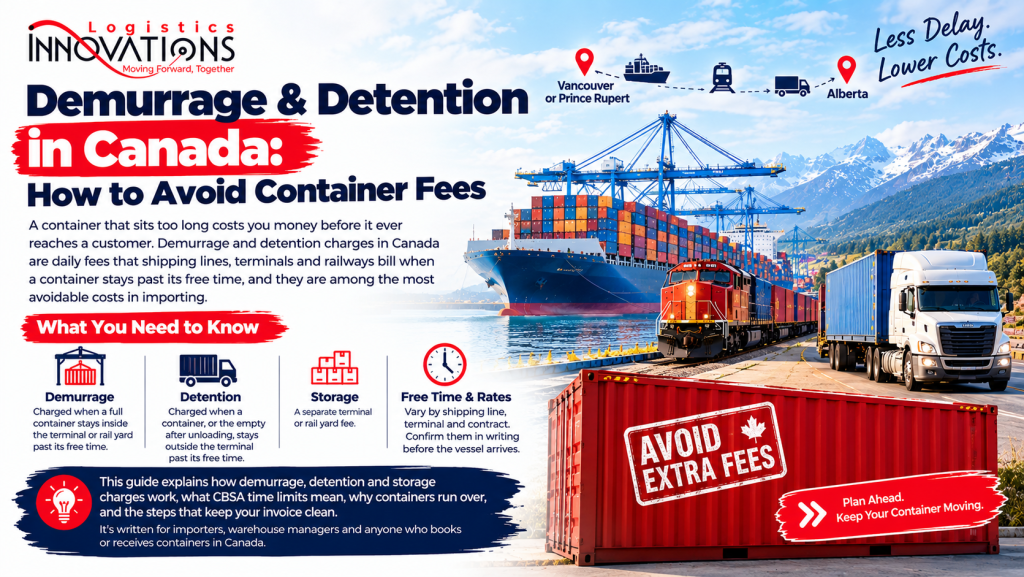
A container that sits too long costs you money before it ever reaches a customer. Demurrage and detention charges in Canada are daily fees that shipping lines, terminals and railways bill when a container stays past its free time, and they are among the most avoidable costs in importing. For businesses bringing goods through Vancouver or Prince Rupert and onward to Alberta, the risk is higher because the container passes through several handoffs: the marine terminal, a rail ramp, a trucker and finally your dock. Each handoff has its own clock.
This guide explains how demurrage, detention and storage charges work, what the Canada Border Services Agency (CBSA) time limits mean, why containers run over, and the steps that keep your invoice clean. It is written for importers, warehouse managers and anyone who books or receives containers in Canada.
Quick answer: Demurrage is charged when a full container stays inside the terminal or rail yard past its free time. Detention is charged when a container, or the empty after unloading, stays outside the terminal past its free time. Storage is a separate terminal or rail yard fee. Free time and daily rates differ by shipping line, terminal and contract, so confirm them in writing before the vessel arrives, book your truck early and make sure your customs paperwork is ready.
What Are Demurrage, Detention and Storage Charges?
These three charges are often grouped together on one invoice, but they run in different places and are triggered by different events.
| Charge | Where the container is | What triggers it | Usually billed by |
|---|---|---|---|
| Demurrage | Inside the marine terminal or rail yard | A full container is not picked up before free time ends | Shipping line or terminal |
| Detention | Outside the terminal, at your site or on the road | The container or empty is not returned before equipment free time ends | Shipping line |
| Storage | In a terminal, depot or rail yard | The container stays beyond the storage period in the facility’s own tariff | Terminal, depot or railway |
The difference matters because fixing one problem does not fix the others. Picking a container up quickly avoids demurrage, but if it then sits loaded at your dock for a week, you can still be charged detention.
Why Alberta Imports Face Three Separate Clocks
Alberta has no seaport, so most imported containers arrive through a West Coast port and travel inland. A typical move can involve a marine terminal, a train to a rail ramp near Calgary or Edmonton, a drayage truck and then your receiving dock. Every stage can have its own free time, tariff and appointment rules, which is why a delay that looks small at the port can grow quickly by the time the container reaches Alberta.
If you want to see the full route in detail, read our guide to shipping containers from Vancouver or Prince Rupert to Alberta, and our intermodal transportation guide for how rail and trucking work together.
Have a Container Arriving Soon?
Talk to the Innovations Logistics team about pickup, delivery and return. Call (587) 315-9722, email info@innovationslogistics.com, or request a free quote.
How Free Time Works
Free time is the number of days you can hold a container before charges begin. There is no single rule. It depends on the shipping line, the terminal or rail yard, the container type and what is written in your contract or the published tariff.
When the Clock Starts
In most cases the clock starts when the container is discharged and available, not when your documents arrive or your truck is booked. A container can be available on Friday while customs is still reviewing your entry, which means free time is being used even though you cannot move the box yet. Ask your forwarder how the carrier defines availability for your specific container.
The Last Free Day
The last free day is the final day you can pick up a container without a charge. Terminals publish it, and it can change if there are holds or schedule shifts. Plan backward from this date instead of the vessel arrival date, and re-check it daily once the ship is in.
Calendar Days or Working Days
Some tariffs count calendar days and others count working days. Around a weekend or holiday, that single detail can move your deadline by several days. Confirm the day-count rule in writing for each shipment.
Daily Rates and Tiers
Many tariffs raise the daily rate after the first billable period, so the second week of delay costs more per day than the first. As a simple example with no real rates attached, if your free time is 4 days and you collect the container on day 8, you are billed for 4 days, and the later days may be priced higher than the earlier ones. Always check the tariff or contract attached to your booking for the actual figures.
Customs, the CBSA and Container Time Limits
Two different clocks can apply to an imported container. One is commercial: the free time set by the carrier or terminal. The other is regulatory: the time limits the CBSA sets for goods held under customs control. They are independent, so a container can be inside the CBSA limit and still be well into demurrage.
According to the CBSA’s Memorandum D4-1-4 on customs sufferance warehouses, these facilities are licensed for the short-term storage and examination of imported goods held in bond until they are released. The memorandum sets these time limits, counted from the day the goods were reported:
| Goods | Time limit |
|---|---|
| General goods | 40 days, after which goods may be moved to a place of safe-keeping |
| Perishable goods | 4 days |
| Certain nuclear substances or items | 14 days |
| Firearms, certain weapons and ammunition, tobacco and vaping products | 14 days, after which they are forfeited |
| Spirits | 21 days, after which they are forfeited |
The CBSA also has a separate policy on extending storage time limits. For most importers the practical lesson is simpler: customs release is a requirement for pickup, so your paperwork is part of your demurrage plan. The CBSA also notes that overseas containers must first be reported at a designated first port of arrival container terminal, where they are screened, and that railways hold imported goods in licensed rail yards until they are released. Our guides to CARM in Canada and importer of record responsibilities explain what to have in place before cargo lands.
The Most Common Reasons Containers Run Over
- Customs holds or missing paperwork. An incomplete invoice, unclear product description or missing importer details can stop release even when the container is physically ready.
- No truck or appointment. A clean release still needs a driver, a compatible chassis and a gate or ramp appointment. If your trucker is booked, the container waits.
- Your dock is not ready. A full warehouse, missing labour or a closed receiving door can leave a delivered container sitting loaded, which turns a demurrage problem into a detention problem.
- Rail or terminal congestion. Delays outside your control are hard to prevent but important to document.
- Payment or document holds. Unpaid freight charges or missing original bills of lading can lock a container even when everything else is ready.
- Late empty return. The cargo is delivered, but the empty misses its return window and detention keeps running.
What These Charges Really Cost
There is no standard price. The bill depends on the carrier, the terminal or rail yard, container size and type, the number of days late and whether rates step up in tiers. Online ranges are wide and should not be treated as a quote for your container. The number that counts is the one in the tariff or contract attached to your booking.
The invoice is also only part of the damage. A late pickup can mean a rebooked appointment, an extra trucking move, idle warehouse labour and a customer waiting for stock. For more on how these costs add up, read our guide to reducing logistics costs for import and export businesses in Canada and our breakdown of drayage costs in Canada.
A Practical Timeline to Avoid Demurrage and Detention
- Before the booking is final: Ask for the free time, day-count rule and rate tiers in writing, and confirm who will be billed.
- While the vessel is at sea: Send complete customs documents to your broker, confirm your importer account is ready, and book drayage so a truck and pickup window are waiting.
- As the vessel arrives: Check the container’s availability and last free day every day, and confirm your receiving appointment at the warehouse.
- When the container is released: Book the gate or rail ramp appointment immediately. Do not wait for the last free day.
- At delivery: Have dock doors, labour and equipment ready so the container is unloaded the same day if possible.
- After unloading: Confirm where the empty must be returned, and when, and return it within the free time.
- After the move: Save gate times, appointment confirmations and emails, which become your evidence if an invoice looks wrong.
Our step-by-step guide to shipping containers from port to warehouse walks through the same process in more detail.
How Drayage, Transloading and Storage Help
Planning the last leg well is the most direct way to protect free time.
- Drayage gets the container from the port or rail ramp to your site. Learn the basics in What Is Drayage? and compare providers with How to Choose a Drayage Company in Canada.
- Warehousing and transloading lets cargo move into a warehouse when your own dock is not ready, which frees the container. See Transloading Services in Canada.
- Bonded shipment support helps eligible cargo move inland under customs control. Read Bonded Shipping in Canada for when it makes sense.
- Container storage gives you a place to hold equipment or cargo while your space is arranged. See Container Storage Solutions for Businesses That Need Extra Space.
Truck Waiting Time Is Not the Same as Ocean Detention
Truckers also use the word detention, but it means something different. Trucking detention is a charge for a driver waiting at a pickup or delivery location beyond the allowed loading or unloading time. Ocean detention is billed by the shipping line for equipment. A container can trigger both if the driver waits at your dock and the empty then returns late. Scheduling the dock so trucks are never idle protects you from both.
Who Pays Demurrage and Detention?
The line or terminal typically bills the party named on the shipping documents, which is often the consignee or notify party on the bill of lading. The final cost can then move to the shipper, buyer, broker or forwarder depending on your sale terms and contracts. A drayage carrier is usually responsible only for charges caused by its own performance, unless your contract says otherwise. Agree who carries delay costs before the shipment moves, not after the invoice arrives.
How to Dispute a Demurrage or Detention Invoice
- Build a timeline. Collect the discharge date, availability date, customs and carrier release times, gate records, appointment confirmations and any emails about holds or closures.
- Check the terms. Compare the invoice with the free time, day-count rule and rates in your contract or the published tariff.
- Identify delays you did not cause. Terminal closures, system outages, missing appointment slots or authority holds may support a dispute.
- Raise it promptly. Use the carrier’s stated dispute process, attach your evidence and ask your forwarder or broker to help.
Not every charge can be removed, and rules and protections vary by country, port and contract, so confirm what applies to your shipment with your forwarder or a qualified adviser.
How Innovations Logistics Helps Importers Keep Containers Moving
Innovations Logistics supports importers with drayage, intermodal service, warehousing and transloading, bonded shipments, freight forwarding and container storage, rental and repair. When these steps are planned together, there are fewer handoffs and fewer gaps where free time can disappear. For an overview of what a forwarder manages, see Door to Door Freight Forwarding, and once your cargo is moving you can track your shipment online.
Frequently Asked Questions
What is the difference between demurrage and detention?
Demurrage applies while a full container is inside the terminal or rail yard past its free time. Detention applies once the container or empty is outside the terminal and not returned within the allowed time. Both can apply to the same container.
How many free days do I get?
It depends on the shipping line, terminal, container type and contract. The only reliable number is the one in your booking terms or the published tariff, confirmed in writing before the shipment.
When does demurrage start?
Usually after free time ends, counted from when the container is discharged and available. A customs hold does not usually stop the clock, so ask how your carrier defines availability.
What is the last free day?
It is the final day you can collect a container without a charge. It can change if there are holds or schedule shifts, so check it daily once the vessel has arrived.
Do weekends count toward free time?
It depends on the terms. Some tariffs use calendar days and some use working days. Confirm the rule for your shipment, especially around weekends and holidays.
Is storage the same as demurrage?
No. Storage is a separate fee set by the terminal, depot or rail yard, and it may be billed separately from the shipping line’s charges.
How long can imported goods stay in a Canadian sufferance warehouse?
According to CBSA Memorandum D4-1-4, general goods not removed within 40 days of being reported may be moved to a place of safe-keeping, with shorter limits for perishables and certain regulated goods. These limits are separate from a carrier’s free time.
Who pays demurrage, the shipper or the consignee?
The party named on the shipping documents is usually billed first, often the consignee. The final cost can move to the shipper, buyer or forwarder depending on sale terms and contracts.
Can demurrage and detention charges be disputed?
Sometimes. A dispute is stronger when you can show timestamps, release records and emails proving the delay was outside your control. Success depends on your contract and the applicable tariff.
How can I avoid demurrage in Canada?
Confirm free time in writing, send customs documents early, book drayage and a delivery appointment before arrival, collect the container as soon as it is released, unload quickly and return the empty on time.
Plan Your Next Container Move With Us
Tell us your port, container details and delivery location, and our team will help you plan pickup, delivery and return. Call (587) 315-9722, email info@innovationslogistics.com, or request a free quote today.