
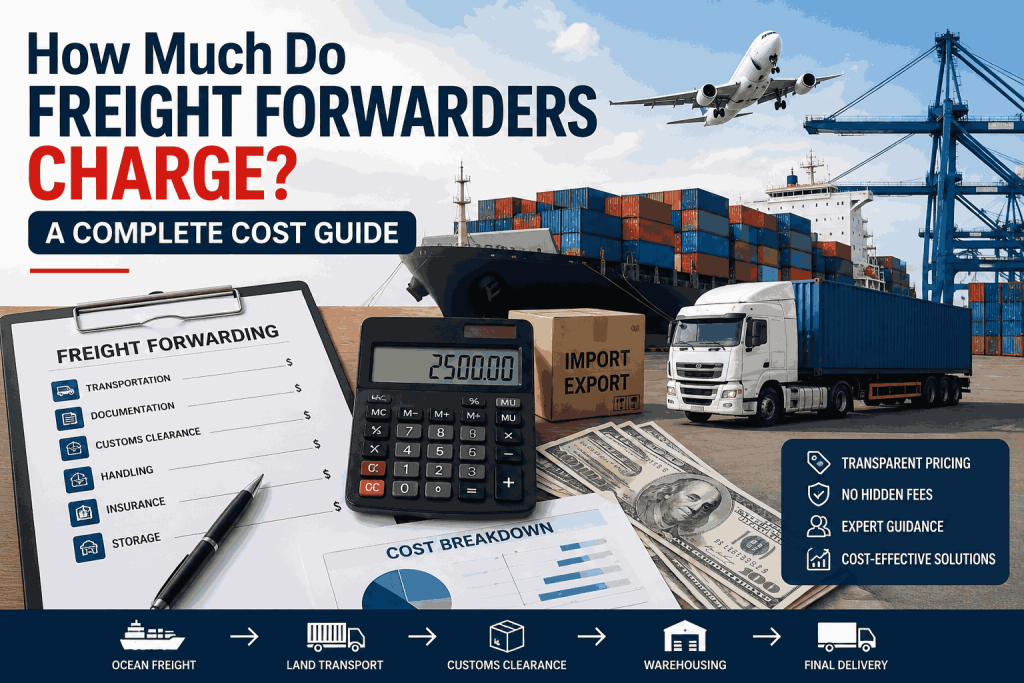
If you are importing or exporting goods in Canada, knowing how much do freight forwarders charge can help you avoid expensive surprises. A freight forwarder does more than move cargo. The final bill can include transportation, documentation, customs clearance, terminal handling, storage, delivery, and other services.
There is no single freight forwarder cost that applies to every shipment. Your price depends on the shipping method, cargo size, weight, route, origin, destination, Incoterm, customs requirements, and delivery needs.
Current Canadian freight pricing guides show just how wide the range can be. For example, published 2026 market estimates for China to Vancouver show LCL ocean freight around CAD $180 to $280 per cubic metre, while 40 foot container freight can run roughly CAD $3,500 to $7,000 before several destination charges.
This guide explains freight forwarder fees, what they cover, what you may pay in Canada, and how to compare quotes before booking.
How Much Do Freight Forwarders Charge in Canada?
Freight forwarders normally do not charge one flat fee. Freight forwarding charges are made up of several costs related to moving and managing your shipment.
For a Canadian importer, a typical quote may include:
- Main freight transportation
- Pickup and inland transportation
- Export documentation
- Terminal handling
- Customs clearance
- Freight forwarder service fees
- Delivery to your warehouse
- Fuel or carrier surcharges
- Storage when applicable
- Duties and taxes, depending on the shipping arrangement
As a general budgeting guide, current published Canadian freight examples include:
Service | Example market range |
LCL ocean from China to Vancouver | CAD $180 to $280 per CBM |
20 foot FCL from China to Vancouver | CAD $2,800 to $5,500 |
40 foot FCL from China to Vancouver | CAD $3,500 to $7,000 |
Air freight from China to Canada | CAD $12 to $22 per kg |
Customs brokerage | Often about CAD $75 to $200, depending on shipment and service |
These figures are planning ranges, not fixed Canadian tariffs. Carrier rates, fuel costs, port conditions, cargo specifications, season, and destination can change the final price.
What Makes Up Freight Forwarding Costs?
Understanding each part of a quote makes it much easier to compare freight forwarders.
1. Ocean or Air Freight
This is the main transportation charge.
Ocean freight is usually suitable for larger shipments that are not extremely time sensitive. Air freight costs more but can make sense for urgent, high value, or relatively lightweight cargo. If you are comparing the two options, see our guide: Air vs. Ocean Freight
For ocean shipments, you may choose:
LCL: Less than Container Load. You share container space with other shipments and are generally charged based on cargo volume.
FCL: Full Container Load. You book an entire container and normally pay a container rate.
Air cargo is commonly priced according to chargeable weight. The carrier may compare actual weight with volumetric weight and use the higher figure.
2. Freight Forwarder Service Fees
A forwarder may charge for arranging transportation, preparing documents, coordinating carriers, tracking cargo, and managing shipment details.
Published 2026 pricing from one international forwarder lists documentation and coordination fees around $50 to $150 per shipment, although the actual amount varies by company and service package.
Some forwarders include these costs in the main freight rate instead of showing them as a separate line.
3. Customs Brokerage Fees
Customs clearance is an important part of freight forwarding fees in Canada.
A customs broker can prepare and submit import documentation, classify goods, and help arrange release through the Canada Border Services Agency.
Canada requires commercial importers to follow customs procedures and pay applicable duties and taxes. The CBSA also uses the CARM system for commercial import accounting and revenue management.
Brokerage pricing varies. For example, one Canadian customs brokerage currently lists basic brokerage starting around CAD $64 for truck shipments and CAD $84 for ocean and air shipments, with additional charges for extra classifications, invoices, declarations, and disbursements.
These are provider examples, not standard Canadian government fees.
4. Terminal and Handling Charges
Your cargo may incur handling charges at the origin and destination.
These can include:
- Terminal handling
- Container handling
- Cargo unloading
- Documentation
- Warehouse handling
- Container freight station charges for LCL cargo
For containerized shipments, drayage can also become an important part of the cost when moving containers between ports, terminals, rail facilities, and warehouses.
For example, a current 2026 Canadian market guide estimates destination terminal handling at roughly CAD $350 to $600 for a 40 foot container in Vancouver.
5. Inland Transportation
Your shipment still needs to reach the final destination.
That may mean trucking from a Canadian port such as Vancouver, Montreal, Halifax, or another entry point to your warehouse.
Depending on the shipment size and delivery requirements, you may use LTL or FTL transportation. See our guide to FTL vs. LTL in Canada for a closer comparison of the two options.
The cost depends heavily on distance, shipment size, delivery location, appointment requirements, and equipment needed.
6. Fuel and Other Surcharges
Carriers may apply fuel surcharges and other variable charges.
Additional costs can also arise from:
- Port congestion
- Special cargo handling
- Residential delivery
- Liftgate service
- Refrigerated transportation
- Storage
- Customs examination
- Demurrage or detention
This is why the cheapest base freight rate does not always produce the lowest final shipping cost.
Freight Forwarder Pricing by Shipping Method
Ocean Freight
Ocean freight is often the preferred option for large commercial shipments.
For example, a current 2026 guide gives approximate China to Vancouver rates of CAD $2,800 to $5,500 for a 20 foot container and CAD $3,500 to $7,000 for a 40 foot container before all destination costs.
LCL can be useful when you do not have enough cargo to fill a container. Current published estimates vary significantly, which shows why you should request a shipment specific quote rather than rely on a generic rate.
Air Freight
Air freight is generally faster but more expensive.
Current published China to Canada estimates show roughly CAD $12 to $22 per kilogram on some routes.
The actual price depends on chargeable weight, airline capacity, route, fuel charges, shipment dimensions, and service level.
Ground Freight
Ground freight is common for Canadian domestic shipments and cross border movements with the United States.
A ground quote may include pickup, linehaul transportation, fuel charges, customs brokerage, and final delivery.
For cross border shipments, always confirm who handles customs and who pays duties and taxes.
Example: Calculating a Freight Forwarding Cost
Imagine a Canadian business importing goods from China to Toronto.
The shipment has:
- Cargo value of CAD $25,000
- LCL volume of 8 CBM
- Ocean transportation
- Customs clearance
- Delivery from the port to the warehouse
A simplified budget could look like this:
Cost | Example |
Ocean freight | $2,000 |
Origin charges | $300 |
Destination handling | $500 |
Customs brokerage | $150 |
Inland delivery | $900 |
Documentation and other fees | $150 |
Estimated logistics cost | $4,000 |
This is only an example. It does not establish a standard rate, and it does not include applicable duties and taxes.
Canadian importers should also account for GST and potentially customs duties. The CBSA states that imported goods are generally subject to the 5 percent GST and potentially customs duties, with duty depending on factors such as tariff classification, country of origin, and value.
The CRA also notes that GST or the federal part of HST on imported goods is calculated on the Canadian dollar value of the goods, including duty and excise tax where applicable.
What Affects Freight Forwarding Costs?
Several factors can move your quote up or down.
Shipment Weight and Volume: A heavier shipment usually costs more, but dimensions matter too. Large, lightweight cargo can be expensive because carriers may price it according to volumetric weight.
Shipping Route: A shipment from Shanghai to Vancouver will have a different cost structure from one moving from Germany to Montreal or Chicago to Toronto.
Shipping Speed: Urgent air freight costs more than standard ocean freight in most cases.
Cargo Type: Hazardous goods, temperature sensitive products, oversized cargo, and fragile goods may require special handling.
Incoterms: Terms such as EXW, FOB, CIF, and DDP affect which party pays different transportation and import costs.
A low supplier price under one Incoterm may not result in a low landed cost for the Canadian buyer.
Season and Capacity: Freight markets can change quickly as carrier capacity and demand change. Current industry pricing sources also warn that rates can vary based on market conditions and routing.
How to Reduce Freight Forwarding Costs
You do not always need to choose the cheapest freight quote to reduce your total logistics spend.
Try these approaches:
- Compare the total landed cost, not just the base freight rate.
- Consolidate smaller shipments when practical.
- Select the right mode based on urgency and cargo size.
- Provide accurate dimensions and weights when requesting quotes.
- Avoid unnecessary storage, demurrage, and detention charges.
- Review the quote for excluded destination and accessorial charges.
- Plan shipments when possible.
- Check whether your goods qualify for preferential tariff treatment.
- Compare multiple freight forwarders using the same shipment details.
For Canadian importers, correct tariff classification and origin information are particularly important because they can affect the applicable duty rate.
For more practical ways to lower shipping expenses, see our guide on how to reduce freight costs in Canada.
How to Compare Freight Forwarder Quotes
When comparing freight forwarder pricing, ask every provider for the same information.
Provide:
- Origin address
- Destination address
- Cargo description
- Number of packages
- Dimensions
- Gross weight
- Shipping mode
- Required delivery date
- Incoterms
- Customs requirements
Then compare each quote line by line.
The best freight forwarder is not necessarily the company offering the lowest initial number. Look for a provider that gives you a clear breakdown, explains exclusions, communicates well, and can manage the shipment from origin through final delivery.
Get a Freight Forwarding Quote for Your Shipment
Freight forwarding costs are highly dependent on your shipment details. A Canadian business shipping one pallet across the U.S. border will have very different costs from a company importing a full container from overseas.
If you need help planning transportation, customs coordination, cross border freight, or international shipments, Innovations Logistics provides freight forwarding services and logistics solutions for businesses.
Request a quote with your shipment details so the freight cost can be calculated around your actual route, cargo, and service requirements.
Frequently Asked Questions
How much do freight forwarders charge in Canada?
Freight forwarder charges vary based on shipment size, route, transportation method, cargo type, customs requirements, and delivery location. Published 2026 examples for China to Vancouver range from about CAD $180 per CBM for some LCL ocean shipments to several thousand dollars for full containers.
How much does freight forwarding cost for a container?
A 2026 published estimate for China to Vancouver places 20 foot FCL freight around CAD $2,800 to $5,500 and 40 foot FCL freight around CAD $3,500 to $7,000 before various destination charges. Your actual quote may differ substantially.
What are freight forwarder fees?
Freight forwarder fees can cover shipment coordination, documentation, booking, tracking, customs coordination, cargo handling, and other logistics services. Some companies bundle these costs into their freight rate while others list them separately.
Does a freight forwarder charge customs duties?
A freight forwarder or customs broker may arrange payment of duties and taxes on your behalf, but those government charges are different from the forwarder’s service fee. Canadian importers remain responsible for applicable duties and taxes under the import arrangement.
How can I get the lowest freight forwarding cost?
Request several itemized quotes using identical shipment information. Compare the complete logistics cost, not just the ocean, air, or truck rate. Check customs, handling, delivery, fuel, storage, and other possible charges before choosing a provider.
Final Thoughts
So, how much do freight forwarders charge? There is no universal price. A small LCL shipment may cost a few hundred dollars, while a full container can cost several thousand dollars before customs, handling, delivery, and other charges.
The best way to control freight forwarding costs is to understand every line on the quotation. Look at the complete cost from supplier pickup to final delivery, confirm who handles customs, and make sure duties and taxes are clearly identified.
For Canadian importers and exporters, a reliable freight partner can also reduce paperwork, improve shipment coordination, and help prevent avoidable charges.
If you are planning an upcoming shipment and want help reviewing your logistics options, visit Innovations Logistics to learn more about its services and request assistance with your freight requirements.