
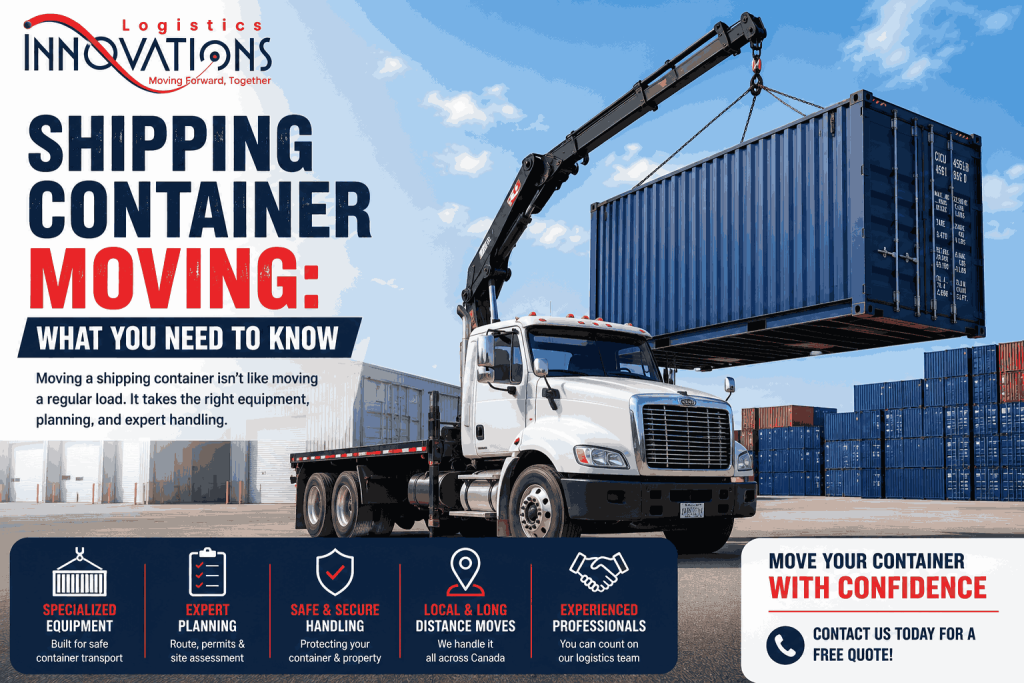
Moving a shipping container is not the same as hiring a regular moving truck. A steel container can be large, heavy, difficult to access, and challenging to position safely. The right truck, equipment, route, and site conditions all matter.
If you need shipping container moving in Canada, planning the move before the truck arrives can help prevent delays, extra charges, and property damage. This guide explains how container moves work, what equipment may be required, what affects the price, and how to choose the right shipping container moving company for your job.
What Is Shipping Container Moving?
Shipping container moving is the transportation of a steel freight container from one location to another. It may involve an empty or loaded container.
Unlike a standard freight shipment, container moving involves specialized equipment: flatbed trucks, tilt-and-load trailers, cranes, and, in some cases, rail service. The container itself does not change; it is the same unit from pickup to delivery. That consistency is a big part of what makes containers so reliable for cargo protection across long distances.
In Canada, container moving covers a wide range of situations: port drayage (moving containers between a port and an inland destination), cross-country commercial freight, residential relocation, and even on-site storage solutions for businesses that need temporary space.
How Shipping Container Moving Works
Most container moves follow a simple process, but the equipment used depends on the container size, weight, location, and destination.
A typical move includes:
- Site assessment: The carrier reviews the pickup and delivery locations, access points, ground conditions, and possible obstacles.
- Container inspection: The container size, condition, weight, and load status are confirmed.
- Equipment selection: The carrier chooses a suitable tilt deck, flatbed, chassis, crane, or other lifting equipment.
- Pickup: The container is secured and loaded onto the transport vehicle.
- Transportation: The container is moved to the new location using a planned route.
- Delivery and placement: The driver positions the container where it needs to go.
- Final inspection: The container and placement area are checked before the job is completed.
For many local moves, tilt deck trucks can pick up and place containers without requiring a large crane. Some loaded or difficult moves need additional lifting equipment.
What Equipment Is Used for Moving Shipping Containers?
The equipment required depends on the job. A professional carrier should select equipment based on the container and site instead of using the same setup for every move.
Tilt Deck Trucks
Tilt deck trucks can load and unload containers by changing the angle of the trailer deck. They are commonly used for smaller and medium container moves where there is enough room for the truck to position itself.
Flatbed Trailers
Flatbeds are useful for longer transportation jobs and certain loaded containers. The container is secured to the trailer and transported to the destination.
Chassis Trailers
Container chassis are designed specifically for transporting standard intermodal containers. They are commonly used for port, rail, and commercial freight operations.
Cranes
A crane may be necessary when a container is too heavy for the selected truck, when the site does not allow a tilt deck to unload safely, or when the container must be lifted over an obstacle.
The correct equipment depends on factors such as container size, total weight, ground conditions, clearance, and the final placement location.
What Should You Check Before Moving a Container?
One of the biggest mistakes people make is focusing only on the container. The pickup and delivery sites can be just as important.
Before cargo container moving, check:
- Available driveway or road width
- Ground firmness and slope
- Overhead wires and branches
- Fences, gates, buildings, and other obstacles
- Turning space for the truck
- Container orientation at the destination
- Distance between the truck and final placement area
- Weight of the loaded container
- Local access restrictions
A container truck needs adequate room to enter, position itself, and safely unload. Soft ground can also create problems because the truck and container combination can be extremely heavy.
For example, one Ontario container provider notes that some container trucks can have a combined weight above 45,000 pounds and require firm ground for safe delivery. SSigma Container
How to Prepare Your Container for Transportation
Before the truck arrives, make sure the container and property are ready.
Container preparation
- Secure all cargo inside the container
- Distribute weight as evenly as possible
- Close and lock the doors properly
- Remove loose items from the exterior
- Tell the carrier if the container has unusual cargo
- Provide the container size and estimated weight
Site preparation
- Clear vehicles from the access area
- Trim or identify overhead obstacles
- Open gates where necessary
- Keep the delivery area clear
- Make sure the ground is firm
- Confirm where the container should face
- Tell the driver about narrow roads or difficult turns
Good preparation gives the driver a better chance of completing the move safely and on schedule.
How Much Does Shipping Container Moving Cost in Canada?
There is no single price for container moving in Canada. A short local move and a long distance loaded container move can have very different costs.
The main cost factors include:
- Distance between pickup and delivery
- Container size
- Empty or loaded condition
- Total cargo weight
- Truck and trailer type
- Crane or special equipment requirements
- Permit requirements
- Route restrictions
- Loading and unloading conditions
- Waiting time
- Remote or difficult access
- Fuel and travel costs
A short local move with an empty 20 foot container may be much simpler than moving a loaded 40 foot container several provinces away.
For this reason, be cautious of a quote based only on container size. Give the carrier complete information about the container, its contents, pickup location, delivery location, and site conditions.
How to Choose a Shipping Container Moving Company
Not every trucking company is equipped for container transport. Before booking, ask these questions:
Can you handle my container?
Confirm the provider can move your container size, type, and total weight.
Can you move loaded containers?
If cargo is inside, confirm that loaded moves are accepted and provide accurate weight information.
Do you cover my route?
For container moving Canada wide, confirm your exact pickup and delivery locations.
What equipment will you use?
Equipment should match the container, weight, route, and delivery site.
Are extra charges explained?
Ask about waiting time, storage, terminal charges, permits, chassis fees, and other possible charges before the move.
Can you coordinate related logistics?
If your move involves rail, ports, warehousing, or transloading, then you need an intermodal transportation provider with broader logistics capabilities to simplify the shipment.
Shipping Container Moving vs Container Drayage
These terms are related, but they are not always the same.
Shipping container moving is a broad term for relocating a container from one place to another. It can include local, regional, commercial, industrial, and site relocation moves.
Container drayage usually refers to short haul movement connecting major transportation points, such as a port, rail terminal, warehouse, or distribution centre.
For example, a container arriving at a Canadian port may need a truck to move it to a rail terminal or warehouse. That short truck movement is a typical drayage move.
Frequently Asked Questions
1. How are shipping containers moved?
Shipping containers are commonly moved using tilt deck trucks, flatbed trailers, container chassis, or cranes. The equipment depends on container size, weight, access, and placement requirements.
2. Can a full shipping container be transported?
Yes. A loaded container can be transported when its total weight is within the equipment and legal limits. The carrier needs accurate information about the container and cargo before selecting equipment.
3. Do I need a permit to move a shipping container in Canada?
Possibly. Permit requirements depend on the province, municipality, route, dimensions, and total vehicle weight. Some moves require oversize or overweight permits.
4. How much does it cost to move a shipping container?
The cost depends on distance, container size, weight, equipment, permits, site conditions, and other transportation requirements. The best way to get an accurate price is to provide the carrier with complete move details.
5. How much space is needed to move a shipping container?
The required space varies by truck and unloading method. The carrier needs enough room for the truck to enter, position itself, unload the container, and leave safely. Overhead clearance and ground conditions must also be considered.
Final Thoughts
Shipping container moving is more than putting a container on a truck and driving to the next location. Safe and efficient transport depends on suitable equipment, accurate weight information, route planning, site access, and clear scheduling.
For businesses moving containers across Canada, a logistics provider can make the process easier and reduce delays. Confirm what the quote includes and make sure the carrier understands both pickup and delivery conditions.
If you need help planning a container move, contact Innovations Logistics to discuss your route, container requirements, and transportation needs.