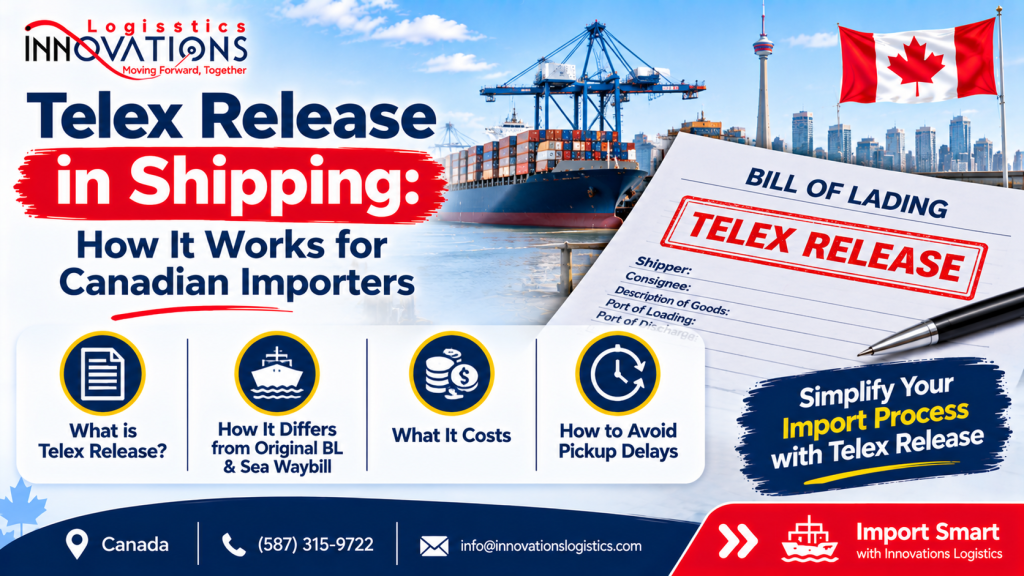
A telex release lets an importer collect cargo without a paper bill of lading. It sounds like a small detail. Yet it often decides whether your container leaves the port today or sits for days. When the paperwork lags, fees start to build.
This guide explains how a telex release works and how it differs from an original bill of lading and a sea waybill. You will also see the costs, the risks and the steps to follow. Finally, you will learn how it affects container pickup in Canada.
Quick answer: A telex release is an electronic message from the carrier’s origin office to its destination office. It allows the named consignee to collect the cargo without the original bill of lading. The shipper must first surrender the full set of originals at origin. This saves courier time. However, the shipper then loses control of the cargo.
What Is a Telex Release?
A bill of lading is the main document for ocean freight. The carrier issues it, and it usually comes in a set of three originals. Normally, the consignee must present an original to collect the cargo.
However, a telex release changes that rule. The shipper hands all the originals back to the carrier at origin. The carrier then tells its destination office to release the cargo to the named consignee. No paper needs to travel.
You may also hear “surrendered bill of lading” or “B/L surrendered”. These terms mean almost the same thing. Carriers often stamp the bill “telex release” or “surrendered”.
How a Telex Release Works
The process has a clear order. Each step needs the one before it.
- The carrier issues the original bills of lading.
- Next, the shipper pays the freight and any origin charges.
- Then the shipper surrenders the full set of originals at origin.
- After that, the shipper or forwarder asks the carrier for a telex release.
- The origin office sends the release message to its destination office.
- The destination office checks the consignee and releases the cargo.
Most carriers process the request within a few days. Some do it faster. Ask your forwarder for the expected timing.
Telex Release vs Original Bill of Lading
An original bill of lading is a document of title. Whoever holds a properly endorsed original controls the cargo. Therefore, the consignee must present it at destination.
The original must travel by courier. Industry guides say that can take several days and cost roughly $50 to $150. In contrast, a telex release moves by message in a short time.
- Original bill: It acts as a document of title, but it can arrive late.
- Telex release: It is faster, but the shipper gives up control after surrender.
A letter of credit adds another factor. Banks usually ask for original bills. As a result, a telex release is rarely accepted for those sales. Check the credit terms before you choose.
Sea Waybill and Express Release
A sea waybill is a different document. The carrier never issues originals for it. It is not a document of title, so nothing needs surrender.
The named consignee collects the cargo after the carrier checks identification. Many carriers call this an express release. Also, it is simple and fast.
The key difference is origin. A telex release starts as an original bill, and the shipper surrenders it. A sea waybill never has originals at all. The shipper can usually change the consignee on a waybill until the carrier releases the cargo.
When Each Release Method Makes Sense
No method fits every sale. Match it to your trust level and payment terms.
- Use an original bill when a bank or the buyer needs title control.
- A telex release fits when the sale is settled and speed matters.
- A sea waybill suits buyers and sellers who trust each other.
- Shipments between offices of the same company can use a sea waybill too.
Our guide to Incoterms in Canada explains how sale terms shape who handles these documents.
Waiting on a release before pickup? Talk to our team about the truck. Call (587) 315-9722, email info@innovationslogistics.com, or request a free quote.
Telex Release Costs and Timing
A telex release usually carries a small fee. Carriers often charge about $25 to $100 per bill of lading. Some include it in the documentation fee. The amount varies by line and port.
Compare that with the courier option. Courier fees can add up, and delays can cost more than the fee. A late original can trigger storage, demurrage and detention.
Always ask your forwarder for the exact fee. Also ask when the carrier posts the release. Our guide to how much freight forwarders charge helps you read the quote.
Risks for Buyers and Sellers
Each side faces a different risk.
- Sellers: After the originals go back, the seller no longer controls who gets the cargo.
- Buyers: The buyer may wait if the seller delays the surrender.
Because of this, sellers often wait for payment before they surrender the originals. Buyers should agree on the timing in the contract. In addition, both sides should confirm the consignee’s name.
A lost original is another risk. The carrier may then ask for a letter of indemnity backed by a bank guarantee. That adds cost and time.
Telex Release, Customs and Container Pickup in Canada
A telex release is only one part of pickup. In Canada, a container usually needs several clearances before a truck can collect it.
- The carrier must release the cargo.
- Customs must release the goods.
- No hold or exam can stand in the way.
- You must also pay any terminal or carrier fees.
The telex release covers only the carrier side. Your customs broker handles the CBSA side. Read our guides to a customs hold in Canada and the cargo control number to see how the two fit together.
Containers that arrive by rail in Calgary or Edmonton follow the same rule. The ramp usually will not release a container without the carrier’s release. Our guide to drayage in Alberta explains the pickup.
How to Get a Telex Release: Step by Step
Follow these six steps with your supplier and forwarder.
Step 1: Agree on the Release Type Early
Ask your supplier which type they will use. Put it in the purchase order.
Step 2: Confirm the Consignee Details
The consignee’s name and address must match your records. A small mismatch can block the release.
Step 3: Pay the Freight and Origin Charges
Carriers usually need the freight paid first. Then ask your supplier to confirm that all charges are clear.
Step 4: Make Sure the Shipper Surrenders All Originals
The shipper must return the full set, usually all three. A partial set will not work.
Step 5: Ask for Written Confirmation
Request proof that the carrier sent the release. Also, ask your forwarder to confirm that the destination office has it.
Step 6: Book the Truck for Pickup
Line up drayage before the ship arrives. Then the container can leave as soon as every release clears.
Common Telex Release Mistakes
- Surrendering only part of the original set.
- Using a consignee name that does not match.
- Skipping the written confirmation.
- Waiting until the ship arrives to ask for the release.
- Forgetting that customs release is separate.
- Choosing a telex release for a letter of credit sale.
Most of these mistakes are easy to avoid. In fact, one early email to your forwarder can prevent them.
How to Avoid Delays at Pickup
Delays often start with documents. Ask about the release type before you buy. Then track the release in the days before arrival.
Also watch your free time. A container that waits for a release still counts days. Our guide to demurrage and detention charges in Canada explains how those fees add up. For the full import process, read how to import goods into Canada.
How Innovations Logistics Supports Your Pickup
Your supplier, carrier, forwarder and customs broker handle the release documents. Innovations Logistics supports the transport and storage once the cargo clears. Our drayage team collects containers from the port or rail ramp. Our warehousing and transloading gives cargo a safe place to wait.
We also offer freight forwarding, intermodal service, bonded shipments and container storage, rental and repair. Once your cargo moves, you can track your shipment online.
Telex Release FAQs
What does telex release mean?
It means the carrier will release the cargo without a paper original. The shipper has surrendered the originals at origin.
Is a telex release the same as a sea waybill?
No. A telex release starts as an original bill that the shipper surrenders. A sea waybill never has originals.
How much does a telex release cost?
Carriers often charge about $25 to $100 per bill of lading. Some include it in other fees, so ask your forwarder.
How long does a telex release take?
Many carriers process it within a few days after the surrender. Timing varies, so ask early.
Who requests a telex release?
The shipper or the shipper’s forwarder requests it. The consignee cannot ask for it alone.
Can I use a telex release with a letter of credit?
Banks rarely accept it. They usually ask for original bills, so check your credit terms first.
Does a telex release clear customs?
No. It only covers the carrier’s release. Your customs broker must still clear the goods with the CBSA.
What if the original bill of lading is lost?
The carrier may ask for a letter of indemnity backed by a bank guarantee. Ask your forwarder for the steps.
This guide is general information. Ask your forwarder or carrier about your own shipment. For another overview, see this explainer on release methods.
Need a truck once your release clears? Tell us your port, container details and delivery location. Call (587) 315-9722, email info@innovationslogistics.com, or request a free quote today.