
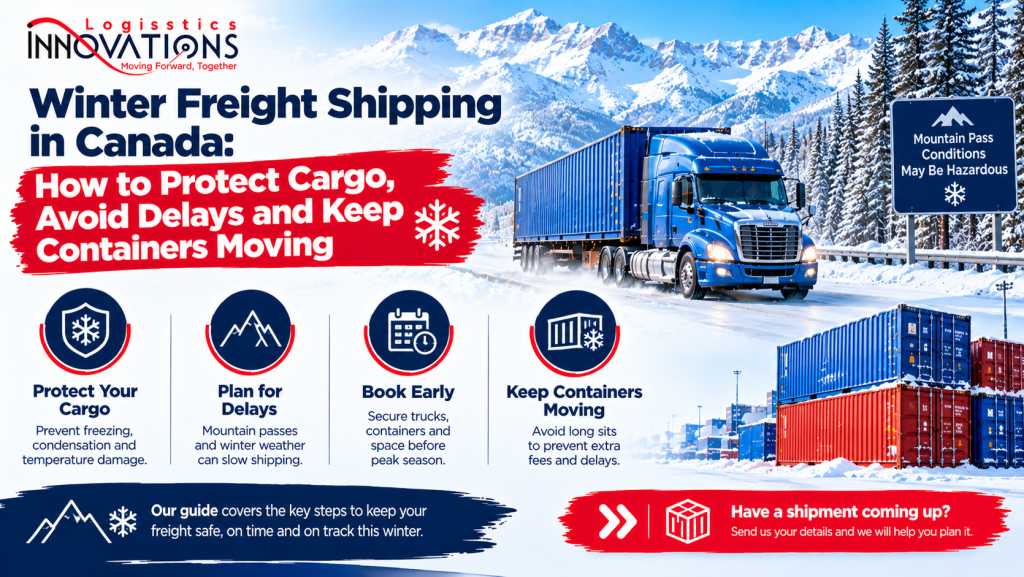
Winter changes how freight moves in Canada. Roads that are fast in July can close for hours in January, trains run slower in extreme cold, yards freeze, doors stick, and the holiday rush puts extra pressure on trucks, drivers and warehouses at exactly the time weather is most likely to cause delays. For businesses shipping between the West Coast, Alberta and the rest of the country, one missed appointment can set off a chain of waiting time, rebooked trucks, storage charges and unhappy customers. The good news is that most winter problems are predictable, and a plan made in October costs far less than a scramble in December.
This guide explains what changes for freight between November and March, what the winter rules on British Columbia’s mountain routes mean for your shipments, which cargo is most at risk from cold, how to protect containers and pallets, and how to build a timeline that keeps your deliveries on schedule.
Quick answer: For winter shipping in Canada, book trucks and containers earlier than you normally would, add buffer days for mountain and Prairie routes, tell your carrier about anything that can be damaged by freezing, package for moisture as well as impact, confirm your receiving dock is cleared and staffed, and move containers quickly so that free time is not wasted by weather delays. A few extra days in your schedule and a few extra questions to your carrier are the cheapest winter insurance you can buy.
Why Winter Freight Needs Its Own Plan
Winter delays are rarely one big problem. They are usually several small ones that stack up: a closure on a mountain pass delays a truck, the truck misses its appointment at the rail ramp or your dock, the container misses its pickup window, the driver’s available hours run out, and the next slot is two days away. Every day a container waits can add storage, demurrage or detention, and every missed delivery can mean a rebooked truck, idle warehouse labour and a customer waiting for stock. Our guide to demurrage and detention charges in Canada explains how those clocks keep running even when the cause is weather.
Winter also overlaps with peak season. Retailers and manufacturers are moving holiday inventory at the same time that capacity is tighter and weather is less forgiving, so a shipment that would be simple in summer can become difficult to place in late November or December. Statutory holidays and year-end shutdowns at warehouses, ports and customers add another layer, because a closed dock cannot receive a container no matter how well the truck did on the road. If you import through the West Coast and move cargo to Alberta, the whole journey is exposed, which is why it helps to understand the route described in our guide to shipping containers from Vancouver or Prince Rupert to Alberta.
What BC’s Winter Rules Mean for Your Shipment
British Columbia’s winter tire and chain rules are one of the clearest examples of how seasonal regulations affect freight. Winter tires, or chains for commercial vehicles, became mandatory on most designated BC highways on October 1, 2026, and the requirement continues until March 31 on many routes or April 30 on select mountain passes and rural routes in high-snowfall areas, according to recent provincial guidance reported in the media. Roadside signs mark where the requirements begin and end, and they are not the same on every highway.
| Topic | What recent BC guidance says |
|---|---|
| Season | Starts October 1. Ends March 31 on many routes and April 30 on select mountain and high-snowfall routes |
| Where it applies | All northern and Interior highways, parts of the South Coast such as the Sea to Sky Highway, and some Vancouver Island routes. Much of the Lower Mainland and southern Vancouver Island is exempt |
| Commercial vehicles | Operators generally must carry chains or an approved traction device on designated routes and use them when a chain-up is in effect |
| Tires | A winter tire must carry the three-peaked mountain and snowflake symbol or the M+S marking, with minimum tread depth requirements |
| Penalties reported in recent winters | About $196 for a commercial vehicle not carrying chains and about $598 for bypassing an active chain-up area. Confirm current amounts with the province |
| Where to check conditions | DriveBC for BC highways and Alberta 511 for Alberta roads |
For shippers, the practical message is that equipment and driver readiness matter as much as the weather. The BC Trucking Association reported that in the winter of 2017 to 2018, most Coquihalla closures were caused by commercial vehicles that were unprepared for conditions, which is why chain-up rules and enforcement were tightened. A carrier that maintains winter-ready equipment and trained drivers is less likely to cause or get caught in a closure, so ask your provider how they prepare. The main mountain corridors between the coast, the Interior and Alberta, including Highways 1, 3 and 5, are designated routes, and closures there can delay freight for hours or days even when the rest of the trip is clear.
Federal hours-of-service rules also limit how long a driver can legally drive, and the adverse-conditions provisions are narrow. A driver cannot be expected to simply push through a storm, so a delay on one leg usually moves the whole schedule. Rules are updated from time to time, so your carrier should confirm the current requirements. If you move freight locally in Alberta, our guides to trucking companies in Edmonton and top trucking companies in Canada can help you compare providers.
Which Cargo Is Most at Risk From Cold
Not every product cares about winter, but some are damaged quickly by freezing temperatures or by the moisture that cold creates. Tell your carrier about anything in the table, and ask whether heated or protected service is available.
| Cargo type | Winter risk | What to do |
|---|---|---|
| Water-based liquids, paints, adhesives, cleaning products | Freezing can split packaging, separate the contents or ruin the product | Ship with protection from freezing, avoid long waits outdoors, and confirm storage conditions |
| Food and beverages | Freezing can damage texture, packaging and quality | Use temperature-controlled or protected service where needed |
| Electronics and batteries | Condensation when cold goods move into a warm space, and reduced battery performance in cold | Allow goods to warm slowly before opening and use moisture protection |
| Plastics, rubber and some packaging | Can become brittle and crack in extreme cold | Handle carefully, avoid rough loading and unloading |
| Paper, cartons, textiles and furniture | Moisture and condensation can cause staining, mould or warping | Keep dry, wrap pallets tightly and consider desiccants in containers |
| Machinery and metal parts | Condensation and moisture can cause rust | Use protective coatings and moisture barriers |
Also check your insurance. Standard cover does not always include freezing or temperature-related damage, so ask your insurer or forwarder what is covered for winter shipments, especially for sensitive cargo.
Containers, Yards and Rail in Cold Weather
Containers bring their own winter issues. When goods that were packed in a warm or humid place are carried through freezing temperatures, moisture can condense inside the container and drip onto cargo, a problem often called container rain. Cartons weaken, labels peel, metal rusts and electronics suffer. You can reduce the risk by packing dry goods, using sealed or wrapped pallets, adding moisture absorbers where suitable, and avoiding opening the container in a warm space while the cargo is still cold. Doors, locks and seals can also freeze in extreme cold, and a frozen yard or poorly cleared dock can slow a driver or make it unsafe to open a container, so ask whether your site is ready to receive one.
Rail is a key link for Alberta imports, and extreme cold and heavy snow can slow trains and affect schedules, so plan more buffer between rail arrival and delivery. Your container still has free time and storage rules at the ramp, and the clock does not stop for weather. Book your drayage before the container is available, confirm your appointment, and ask your provider what happens if the first pickup attempt is delayed. Our guides to intermodal transportation, intermodal vs. truckload and what drayage is explain how rail and trucking fit together.
Need to Book Winter Freight Early?
Tell us your cargo, pickup point and delivery location, and the Innovations Logistics team will help you plan trucks, containers and storage. Call (587) 315-9722, email info@innovationslogistics.com, or request a free quote.
How to Prepare Your Freight for Winter: Step by Step
Step 1: Share Your Winter Forecast Early
Tell your logistics provider what you expect to ship from November through February, which lanes matter most, and which deliveries are fixed by customers or promotions. Early notice lets a provider reserve trucks, drivers, warehouse space and container pickups before the market tightens, and last-minute freight in peak weeks usually costs more and has fewer options.
Step 2: Choose the Right Mode and Add Buffer Days
Compare truckload, LTL, intermodal and rail-plus-drayage for each route, and allow extra days for mountain passes and Prairie highways. If you ship pallets, make sure dimensions, weights and freight class are correct, because errors cause re-class charges and delays. Read FTL vs. LTL in Canada and LTL freight class in Canada before you book.
Step 3: Package for Cold and Moisture
Use sturdy pallets, tight wrap, corner protection and moisture barriers, and avoid packaging that becomes brittle in the cold. Label every pallet clearly with the consignee, reference number and any handling instructions such as “protect from freezing”, and tell your carrier in writing so the instruction travels with the shipment.
Step 4: Confirm Your Receiving Site Is Ready
Check that your yard and dock are cleared of snow and ice, that lighting and heating work, that forklifts and staff are available, and that receiving hours are confirmed, including statutory holidays and year-end closures. A delivery that arrives at a closed or icy dock can create waiting time and detention even if the truck arrived on schedule.
Step 5: Get Customs and Paperwork Done Early
Customs holds are harder to absorb when weather is already delaying your schedule, so send complete documents early. Review the basics in our step-by-step guide to importing goods into Canada and make sure your importer account, financial security and broker instructions are in place before cargo lands.
Step 6: Move Containers Quickly and Know Your Last Free Day
Book drayage before the vessel arrives, collect the container as soon as it is released and return the empty on time. Do not plan to use the last free day, because a closure or storm can take that day away. If weather delays you, document it with emails, appointment confirmations and road condition notices, since this evidence helps if you need to dispute a fee. See how to ship containers from port to warehouse for the full sequence.
Step 7: Keep a Backup Plan
Have a second option ready: another delivery date, a nearby warehouse, a transload or short-term container storage. A backup turns a closure into a minor delay instead of a missed deadline.
Warehousing, Transloading and Container Storage in Winter
Storage becomes more valuable in winter because it gives you flexibility when roads, rail or your own dock are not ready. If weather prevents delivery, warehousing and transloading lets cargo move off the container into a protected space, which frees the equipment and avoids storage fees at the terminal. It also lets you break large loads into smaller deliveries when only part of your site is accessible. Read transloading services in Canada and how much warehousing services cost in Canada to plan the budget.
If you use containers for storage, winter brings its own concerns, such as snow load on the roof, frozen ground and access to the unit, and condensation inside when temperatures swing. Place the container on level, well-drained ground where a truck can reach it, keep it ventilated and dry, and avoid storing freeze-sensitive goods unless the space is protected. Our container storage, rental and repair page and our guides to container storage solutions and storage container rental will help you decide what fits your business.
A Winter Shipping Timeline
| When | What to do |
|---|---|
| Late October to early November | Share your forecast, confirm modes and lanes, review customs setup, check that your carrier has winter-ready equipment |
| Mid November | Book capacity for peak weeks, confirm packaging and labelling, check holiday receiving hours with every consignee |
| Late November to mid December | Build buffer days into every mountain or Prairie delivery, track shipments daily and keep a backup plan |
| Late December and early January | Confirm year-end closures, avoid leaving containers at terminals, communicate delays early |
| January to March | Watch for cold snaps and storms, keep extra buffer on routes that cross mountain passes, plan spring restocking early |
What Winter Delays Really Cost
Weather delays seldom show up as one line on an invoice. They appear as waiting time charged by the trucker when a dock is not ready, detention or storage when a container sits, a rebooked appointment, a second trucking move, idle labour at your warehouse, a late delivery to a customer and, for freeze-sensitive goods, damaged product. The cheapest way to avoid them is to build slack into your schedule: if your container has four days of free time and a storm could take away two, plan to collect it on day two, not day four. For ways to keep the whole logistics budget under control, read how to reduce logistics costs for import and export businesses in Canada and our breakdown of drayage costs in Canada.
Common Winter Shipping Mistakes
The most common mistake is planning winter with summer assumptions: a single delivery day, no buffer, no backup. Others include not telling the carrier that cargo can freeze, using packaging that absorbs moisture, assuming a receiving site is ready without confirming, forgetting holiday closures, leaving containers to sit near the end of free time, and booking late during peak weeks when trucks and drivers are scarce. Shippers also forget to ask about their carrier’s winter equipment, driver training and contingency plans, which matter most when a mountain pass closes. Avoid these by planning early, communicating clearly and having one coordinated team look after the move.
How Innovations Logistics Helps Keep Freight Moving in Winter
Innovations Logistics supports shippers and importers with drayage from ports and rail ramps to your site, intermodal service that combines rail and trucking, warehousing and transloading for protected storage and redistribution, bonded shipment support for cargo moving under customs control, freight forwarding for end-to-end coordination, and container storage, rental and repair for extra space. When these services are planned together, there are fewer gaps where weather can turn a small delay into a missed deadline. To compare providers, read how to choose a drayage company in Canada, and once your cargo is moving you can track your shipment online.
Frequently Asked Questions
When should I book freight for winter?
As early as you can, ideally in October or early November. Share a forecast with your provider so trucks, drivers and warehouse space can be reserved before peak weeks.
Does winter weather delay freight in Canada?
It can, especially on mountain passes and Prairie highways, where closures and slow conditions are common. Build buffer days into every winter delivery.
What are BC’s winter tire and chain rules for trucks?
On designated routes from October 1, commercial vehicles generally must carry chains or an approved traction device and use them when a chain-up is in effect. The season ends March 31 on many routes and April 30 on select mountain routes. Check DriveBC for current rules and routes.
How can I protect cargo from freezing?
Tell your carrier what you are shipping, ask about protected or heated service, avoid long waits outdoors and package against moisture. Check your insurance for freezing damage.
What is container rain?
It is condensation that forms inside a container when temperatures change, which can drip onto cargo. Dry packing, moisture absorbers and slow warming before opening can help.
Do container fees stop during a storm?
Generally not. Free time, storage and demurrage clocks usually keep running, so keep records of weather delays and ask your forwarder or carrier about your options.
Is LTL or truckload better in winter?
It depends on volume, deadlines and budget. Compare options early because capacity in each mode changes quickly in peak weeks.
What if my warehouse is not ready when the container arrives?
Use warehousing, transloading or container storage so the container is not held at the terminal or on a truck, which helps you avoid extra charges.
How do I plan around holiday closures?
Confirm receiving hours with every consignee, set pickup cut-off dates before year-end and tell your provider which deliveries cannot slip.
Plan Your Winter Freight With Us
Tell us what you are shipping, when it needs to arrive and where it is going, and our team will help you plan trucks, containers and storage. Call (587) 315-9722, email info@innovationslogistics.com, or request a free quote today.
Winter road rules, fines and conditions change. Check DriveBC, Alberta 511 and your carrier for current information before you ship.