
Booking the wrong container size is one of the easiest mistakes to make and one of the most expensive to fix. Pick a container that is too small, and you pay for a second one. Pick one that is too large, and you pay for empty space. Pick the wrong type for your delivery site, and your truck may not be able to reach the dock. For businesses importing through Vancouver or Prince Rupert, or moving freight across Canada by rail and truck, container size also affects the chassis, the rail ramp pickup and the final delivery.
This guide covers the container sizes you will actually use in Canada: 20 ft, 40 ft, 40 ft High Cube, 45 ft High Cube and the 53 ft domestic container. You will find dimensions, capacity, payload, pallet counts and a step-by-step method for choosing the right box.
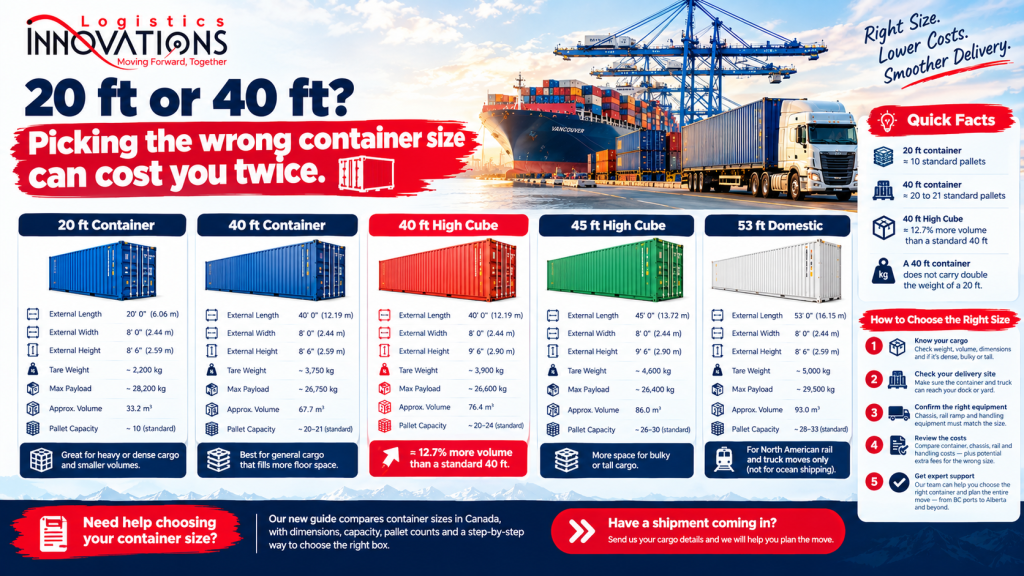
Quick answer: Choose a 20 ft container for heavy or dense cargo and smaller volumes, a 40 ft container for general cargo that fills more floor space, and a 40 ft High Cube for light, bulky or tall cargo because it offers about 12.7% more volume. Use a 53 ft domestic container only for North American rail and truck moves, not for ocean shipping. Always check weight as well as volume, because a larger container does not carry double the payload.
Why Container Size Matters for Canadian Shippers
Container size affects more than the freight rate. It changes how your cargo is loaded, how it travels and who can deliver it.
- Cost per unit: A larger container usually costs less per cubic metre of space, but only if you can fill it without going over weight limits.
- Equipment: 20 ft, 40 ft and 45 ft ocean containers use marine chassis, while 53 ft domestic containers use domestic chassis. They are not interchangeable, so a mismatch can delay your pickup.
- Delivery access: A longer container needs more room to back in, a taller High Cube needs more overhead clearance, and some sites can only receive a 20 ft box.
- Weight on the road: A container can be within its own weight rating and still be too heavy for the truck and chassis combination that must carry it.
- Fees: Late pickup or return of any size can trigger storage, demurrage or detention. See our guide to demurrage and detention charges in Canada.
Container Size Basics You Need to Know
TEU and FEU
Shipping lines count capacity in twenty-foot equivalent units. A 20 ft container is 1 TEU, and a 40 ft container is 2 TEU, also called one forty-foot equivalent unit (FEU). When you see freight quoted per TEU or per FEU, this is what it means.
External vs. Internal Dimensions
External dimensions follow international standards, which is why a 20 ft or 40 ft container looks the same everywhere. Internal dimensions are smaller because of the walls, floor and doors, and they vary slightly by manufacturer. Always plan your load using internal dimensions.
Tare, Payload and Maximum Gross Weight
Tare is the weight of the empty container. Payload is the cargo weight it can carry. Maximum gross weight is tare plus payload. Many standard 20 ft and 40 ft containers are rated up to about 30,480 kg (67,200 lb) gross, although some units are rated higher or lower.
Door Opening
The door opening is smaller than the inside of the container. If you ship a large item, check its height and width against the door opening, not the internal dimensions.
Standard Dry Container Dimensions and Capacity
The table below shows typical values for standard dry containers. These are representative figures from carrier and forwarder specification sheets. The exact numbers can differ by container maker and by shipping line, so confirm the details for the unit you receive.
| Specification | 20 ft Standard | 40 ft Standard | 40 ft High Cube | 45 ft High Cube |
|---|---|---|---|---|
| External length x width x height | 6.06 x 2.44 x 2.59 m (20 x 8 x 8.5 ft) | 12.19 x 2.44 x 2.59 m (40 x 8 x 8.5 ft) | 12.19 x 2.44 x 2.90 m (40 x 8 x 9.5 ft) | 13.72 x 2.44 x 2.90 m (45 x 8 x 9.5 ft) |
| Internal length x width x height | about 5.90 x 2.35 x 2.39 m (19.4 x 7.7 x 7.8 ft) | about 12.03 x 2.35 x 2.39 m (39.5 x 7.7 x 7.8 ft) | about 12.03 x 2.35 x 2.70 m (39.5 x 7.7 x 8.8 ft) | varies by unit |
| Door opening width x height | about 2.34 x 2.28 m (7.7 x 7.5 ft) | about 2.34 x 2.28 m (7.7 x 7.5 ft) | about 2.34 x 2.58 m (7.7 x 8.5 ft) | varies by unit |
| Capacity | about 33.2 m3 (1,172 cu ft) | about 67.7 m3 (2,389 cu ft) | about 76.3 m3 (2,690 cu ft) | about 86 m3 (3,040 cu ft) |
| Tare weight (empty) | about 2,300 kg (5,070 lb) | about 3,750 kg (8,270 lb) | about 3,900 kg (8,600 lb) | varies by unit |
| Typical payload | about 25,000 to 28,200 kg | about 26,500 to 28,750 kg | about 26,300 to 28,600 kg | varies by unit |
| TEU | 1 | 2 | 2 | 2.25 (often counted as 2) |
20 ft Container
The 20 ft container is the best choice for heavy, dense cargo such as machinery parts, tiles, paper, canned goods and building materials. Its payload is about the same as a 40 ft container, so it can carry heavy loads without wasting space. It is also easier to place on a tight site and is a common size for storage and rental.
40 ft Container
The 40 ft container has about twice the volume of a 20 ft container, but it does not carry twice the weight. In representative specification sheets, the payload of a 40 ft unit is only a few hundred kilograms higher than a 20 ft unit. It is a good fit for general cargo such as consumer goods, furniture, cartons and palletized freight that fills space before it reaches the weight limit.
40 ft High Cube
A 40 ft High Cube has the same length and width as a standard 40 ft container but is one foot taller on the outside. That extra height adds about 8.6 m3 of capacity, roughly 12.7% more volume. It suits light, bulky or tall cargo such as furniture, packaged goods and equipment that is limited by volume instead of weight. The tradeoff is a slightly higher tare weight and more overhead clearance needed during transport.
45 ft High Cube
The 45 ft High Cube offers about 86 m3 of capacity for very bulky freight. It is less widely available than 20 ft and 40 ft units and not every shipping line, terminal or chassis pool supports it, so confirm availability early.
53 ft Domestic Containers in Canada
A 53 ft container is a North American domestic size built for rail and highway moves. It is not used on ocean vessels in the normal course of trade, and it requires a domestic chassis, not a marine chassis. CN’s equipment sheet for its 53 ft high-cube container lists the figures below.
| Specification | 53 ft High Cube Domestic Container |
|---|---|
| Interior length | about 52 ft 4 in (15.95 m) |
| Interior width | about 98 in (2.49 m) |
| Interior height | about 109 in (2.77 m) |
| Usable cube | about 3,901 cu ft (110 m3) |
| Pallets (48 x 40 in) | up to 30, depending on loading pattern |
This is roughly 45% more cubic capacity than a 40 ft High Cube ocean container. Other providers quote about 26 pallets for a conventional single-layer pattern, so the number depends on how you load.
A common use in Canada is to unload an ocean container at a transload facility and reload the freight into a 53 ft container for rail or truck delivery across the country. See our guide to transloading services in Canada, and read intermodal vs. truckload shipping in Canada for how these moves compare.
Not Sure Which Container Size You Need?
Send us your cargo size, weight and delivery location, and the Innovations Logistics team will help you plan the move. Call (587) 315-9722, email info@innovationslogistics.com, or request a free quote.
How Many Pallets Fit in a Container?
For palletized cargo, floor positions matter more than cubic volume. The table shows typical single-layer counts. Pallets can often be stacked if the load height, weight and packaging allow it.
| Container | Standard 48 x 40 in pallets | Euro pallets (1.2 x 0.8 m) |
|---|---|---|
| 20 ft | about 10 | about 11 |
| 40 ft or 40 ft High Cube | about 20 to 21 | about 23 to 24 |
| 53 ft domestic | about 26 to 30 | not typical |
Planning Loose Cartons by Volume
For loose cartons, work from cubic metres (CBM). A common planning rule is to aim for about 80 to 90 percent of the usable cube, because packing gaps and loading patterns reduce the space you can really use. As rough guides for loose cargo, a 20 ft container holds about 28 CBM, a 40 ft container about 58 CBM, and a 40 ft High Cube about 65 to 68 CBM. Use these only for early planning and confirm with your forwarder.
Weight Limits: Payload Is Not the Only Limit
A 40 ft Container Does Not Carry Double the Weight
A 40 ft container is about twice as long as a 20 ft container, but its steel frame is heavier, so its payload is only slightly higher. If your cargo is dense, you may reach the weight limit in a 20 ft container long before you fill the space, and a 40 ft container will not solve that.
Road Weight Limits Can Be Lower Than Container Ratings
Roads, not containers, often set the real limit. Each province sets legal weight limits for trucks, and what you can legally carry depends on the truck, the chassis and its axle configuration. A container that is within its own rating can still be too heavy to move on a standard setup. Tell your trucker the actual cargo weight before pickup, ask whether a heavier-duty chassis is needed, and avoid surprises at the gate.
Verified Gross Mass for Exports
International rules require a verified gross mass for packed containers before they are loaded on a vessel. If you export by sea, confirm the process with your freight forwarder or shipping line so your container is not held back.
How to Choose the Right Container Size: Step by Step
Step 1: Measure Your Cargo
Record the length, width, height and weight of every piece, pallet or carton. Include packaging and pallets in your measurements, not just the product.
Step 2: Calculate Volume and Pallet Positions
Add up the total cubic metres for loose cargo, or count the pallet positions for palletized freight. Compare the total with the capacity and pallet tables above.
Step 3: Check Door Openings
Confirm that your largest piece fits through the door opening, which is smaller than the interior. Items taller than the standard door opening need a High Cube or a different container type.
Step 4: Compare Weight and Volume
Check which limit you reach first. If you hit the weight limit first, a 20 ft container is often better. If you run out of space first, consider a 40 ft or a High Cube.
Step 5: Confirm Delivery Access
Check your receiving site for dock height, yard space, turning room and overhead clearance such as wires or canopies. A High Cube on a chassis is tall, and a longer container needs more room to maneuver. Ask your trucker to review the site if you are unsure.
Step 6: Confirm the Chassis and Drayage Plan
Make sure the right chassis is available for your container size and that a truck is booked before the container arrives. Read what drayage is and compare costs in our guide to drayage costs in Canada.
Step 7: Compare Quotes for Two Sizes
Ask for pricing on at least two container options, such as one 40 ft and two 20 ft containers, or a 40 ft against a 40 ft High Cube. The cheapest freight rate may not be the cheapest total cost once trucking, handling and delays are added.
Which Container Size for Which Cargo?
| Cargo or situation | Usually the better fit | Why |
|---|---|---|
| Heavy, dense goods (tiles, machinery parts, paper, canned goods) | 20 ft | Reaches weight limits before filling space, and a 40 ft adds little payload |
| General palletized freight | 40 ft | More floor positions for the same handling |
| Light, bulky or tall goods (furniture, packaged consumer goods) | 40 ft High Cube | About 12.7% more volume than a standard 40 ft |
| Very bulky freight | 45 ft High Cube | Largest ocean option, if available on your route |
| Cross-Canada or North American rail and truck moves | 53 ft domestic | Matches highway trailer capacity and domestic rail service |
| Tight delivery site or small shipment | 20 ft | Easier to place and maneuver |
| Tall or oversized pieces | High Cube, open top or flat rack | Larger opening or loading from above or the side |
Other Container Types You May Need
Open Top Containers
Open top containers have a removable cover so cargo can be loaded from above. They suit tall or heavy items that cannot pass through the doors.
Flat Rack Containers
Flat racks have no roof or side walls and are used for oversized cargo such as machinery and construction equipment.
Refrigerated Containers
Refrigerated containers control temperature for food, medicine and other perishable goods. They have less internal space than a dry container of the same length because of the insulation and cooling equipment.
Container Sizes for Storage and Rental in Canada
Many businesses use containers for storage as well as shipping. The 20 ft container is a common choice because it is easier to place on a site, while a 40 ft container gives more space for inventory, equipment or seasonal stock. Some suppliers also offer smaller or larger units, so confirm what is available in your area. Before you decide, compare renting with buying in our guides to storage container rental, shipping container rental costs and how much a shipping container costs in Canada. If you need extra space, read container storage solutions for businesses, and if you need to move a container, see shipping container moving.
Common Container Size Mistakes to Avoid
- Planning with external dimensions. Always use internal dimensions and door openings.
- Ignoring weight. A container can have space left and still be at its weight limit.
- Assuming a 40 ft carries double. Payload is only slightly higher than a 20 ft.
- Forgetting the delivery site. A truck must be able to reach and unload the container.
- Mixing chassis types. A 40 ft ocean container will not fit a 53 ft domestic chassis.
- Booking too late. Containers and trucks can be hard to find at short notice, especially in busy periods.
- Packing to 100 percent. Leave room for loading gaps, dunnage and securing the load.
How Container Size Affects Your Route to Alberta
If your containers arrive at Vancouver or Prince Rupert and travel by rail to Alberta, the size you book also affects pickup at the rail ramp, the chassis used for delivery and the loading dock you need. Read our guide to shipping containers from Vancouver or Prince Rupert to Alberta for the full route, and our step-by-step guide to shipping containers from port to warehouse for the last leg.
How Innovations Logistics Helps
Innovations Logistics supports importers with drayage, intermodal service, warehousing and transloading, bonded shipments, freight forwarding and container storage, rental and repair. Whether you ship in a 20 ft, 40 ft or High Cube container, planning the equipment, the truck and the receiving site together keeps your cargo moving. For help comparing freight costs, read how much freight forwarders charge, and once your cargo is moving, you can track your shipment online.
Frequently Asked Questions
What are the standard shipping container sizes in Canada?
The most common ocean container sizes are 20 ft, 40 ft and 40 ft High Cube, with 45 ft High Cube available on some routes. For domestic rail and truck moves, the 53 ft container is common.
What is the difference between a 40 ft container and a 40 ft High Cube?
They have the same length and width, but a High Cube is one foot taller. That adds about 12.7% more volume, which helps with light, bulky or tall cargo.
How many pallets fit in a 20 ft container?
About 10 standard 48 x 40 inch pallets or about 11 Euro pallets in a single layer. Stacking can increase this if your load allows.
How many pallets fit in a 40 ft container?
About 20 to 21 standard pallets or about 23 to 24 Euro pallets in a single layer.
Is a 40 ft container twice the capacity of a 20 ft container?
In volume, yes, it is just over double. In weight, no. The payload is only slightly higher because the larger container is heavier.
What is a TEU?
A TEU is a twenty-foot equivalent unit. A 20 ft container is 1 TEU, and a 40 ft container is 2 TEU.
Can a 53 ft container go on a ship?
53 ft containers are mainly built for North American rail and highway use and are generally not used on ocean vessels in normal international trade.
Can a 20 ft container be delivered to my site?
Often yes, but it depends on access, turning room, ground conditions and how the container will be unloaded. Check with your trucker before you book.
Which container size is cheapest to ship?
It depends on your cargo and route. A 40 ft container often costs less per cubic metre, but a 20 ft container may be cheaper overall for heavy goods or small volumes. Compare total cost, including trucking and handling.
How do I know my cargo will fit?
Measure the cargo, calculate cubic volume and pallet positions, check weight and door openings, and ask your freight forwarder to confirm the equipment before booking.
Plan Your Container Move With Us
Tell us what you are shipping, how much it weighs and where it is going, and our team will help you choose the right equipment. Call (587) 315-9722, email info@innovationslogistics.com, or request a free quote today.