
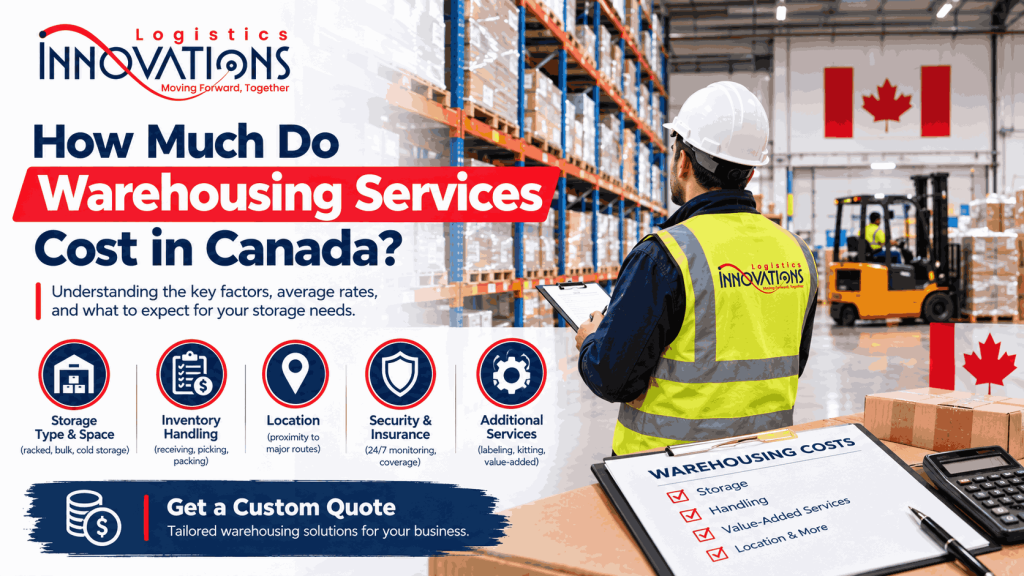
Standard pallet storage in Canada commonly costs around C$15 to C$30 per pallet per month, although rates can be higher depending on location, storage type, volume, and services. Storage is only one part of the bill. Receiving, handling, picking, packing, transportation, and special services can increase the final cost.
This guide explains warehousing costs in Canada, common pricing models, the main cost factors, and how to compare providers.
Average Warehouse Cost Per Pallet in Canada
For a quick reference, here is what businesses are typically paying right now:
- Standard pallet storage: $15 to $30 per pallet, per month
- Inbound/receiving fee: $10 to $25 per pallet
- Outbound/shipping prep fee: $10 to $25 per pallet
- Monthly minimum billing: $400 to $700 or more
- One-time setup or onboarding fee: $250 to $1,000 (often waived for straightforward accounts)
These are base rates for ambient, non-specialized storage. Cold storage, hazardous goods handling, or bonded warehousing usually cost more due to the equipment, licensing, and compliance involved.
Location plays a big role too. Warehouses in high-demand hubs like Toronto, Vancouver, and Montreal tend to be priced higher than facilities in smaller markets, simply because industrial real estate and labour cost more in those areas. If your supply chain can tolerate a slightly longer transit leg, storing goods outside a major metro can meaningfully reduce your monthly bill.
What Affects Warehousing Services Cost
No two quotes look the same because pricing depends on several moving parts:
- Location: Facilities near ports, rail yards, and major highways charge a premium for accessibility.
- Storage format: Pallet storage, bulk floor storage, and bin or shelf storage are priced differently based on how much space and labour each requires.
- Volume and commitment length: Higher volume and longer contracts usually unlock lower per-pallet rates.
- Add-on services: Pick and pack, kitting, labeling, and cross-docking are billed separately from storage.
- Seasonality: Peak season, especially in the lead-up to the holidays, often comes with temporary storage surcharges.
- Technology access: Real-time inventory tracking through a warehouse management system (WMS) can add a small monthly fee but usually pays for itself in fewer errors and better visibility.
Cost Breakdown by Warehousing Service Type
Beyond base storage, most warehousing quotes include several line items:
- Storage fees: Charged monthly, based on pallet count or square footage used.
- Receiving fees: A per-pallet or per-container charge to unload, inspect, and put away inbound goods.
- Pick and pack fees: For businesses fulfilling individual orders, expect roughly $2.50 to $4.00 for the first item picked and packed, plus $0.25 to $0.75 for each additional item in the same order.
- Value-added services: Kitting, co-packing, labeling, and cross-docking are typically billed hourly or per unit, depending on the complexity.
- Setup and account fees: A one-time cost to onboard your inventory and integrate with your systems.
Providers that combine warehousing and transloading services under one contract can often reduce total cost by cutting out the extra handoff between a separate warehouse and a separate trucking company.
In-House Warehousing vs. Outsourced 3PL Warehousing Costs
Businesses weighing whether to lease their own space or work with a third-party logistics (3PL) provider should compare more than just the monthly rate.
In-house warehousing:
- Requires upfront investment in a lease, racking, equipment, and staff
- Fixed costs stay the same even during slow months.
- Full control over operations, but also full responsibility for staffing and compliance
Outsourced 3PL warehousing:
- Costs scale with your actual volume, so you are not paying for space
- No upfront capital investment in a facility or equipment
- Access to existing staff, technology, and carrier relationships
For growing or seasonal businesses, outsourced warehousing usually works out cheaper on a per-unit basis because you are not carrying fixed overhead during quiet periods. If you are still deciding between providers, our guide on how to choose a warehousing company in Canada walks through what to look for beyond price.
How to Lower Your Warehousing Costs in Canada
A few practical steps can bring your warehousing bill down without sacrificing service quality:
- Consolidate inbound shipments so you pay fewer receiving fees per unit of inventory.
- Negotiate rates if you can commit to a longer term or higher pallet count.
- Track SKU velocity and clear out slow-moving stock, since long-term storage penalties can be one and a half to three times the standard rate.
- Use cross-docking where possible to move goods straight from inbound to outbound without paying for storage at all.
- Bundle warehousing with drayage so container pickup and delivery are coordinated by the same drayage service provider, reducing delays and extra trucking charges.
Frequently Asked Questions
How much does warehousing cost per month in Canada?
Most businesses pay a monthly minimum of $400 to $700, plus $15 to $30 per pallet stored and additional fees for receiving and handling. Total monthly cost depends heavily on pallet count and any value-added services used.
What is the average warehouse cost per pallet in Canada?
Standard pallet storage averages $15 to $30 per pallet per month. Inbound and outbound handling fees are billed separately, usually $10 to $25 per pallet each way.
Is outsourced warehousing cheaper than renting your own space?
For most small and mid-sized businesses, yes. Outsourced warehousing avoids the upfront cost of a lease, racking, and staff, and costs scale with actual volume instead of staying fixed year-round.
Do warehousing companies charge fees beyond storage?
Yes. Expect separate charges for receiving, pick and pack, kitting or labeling, and sometimes a one-time setup fee. Always ask for a full rate card rather than just the per-pallet storage price.
How can I get an accurate warehousing quote?
Share your average pallet count, expected order volume, any special handling needs, and how long you plan to store goods. Providers price based on these details, so the more specific you are, the more accurate the quote will be.
Final Thoughts
Warehousing costs in Canada vary based on location, volume, and the services layered on top of basic storage, but most businesses can expect to pay somewhere between $15 and $30 per pallet monthly, plus handling fees. Understanding these cost drivers before you request quotes puts you in a much better position to compare providers fairly and avoid surprise charges later.
If you want a clear, itemized quote for your business, contact Innovations Logistics and our team will walk you through pricing based on your actual volume and storage needs.