

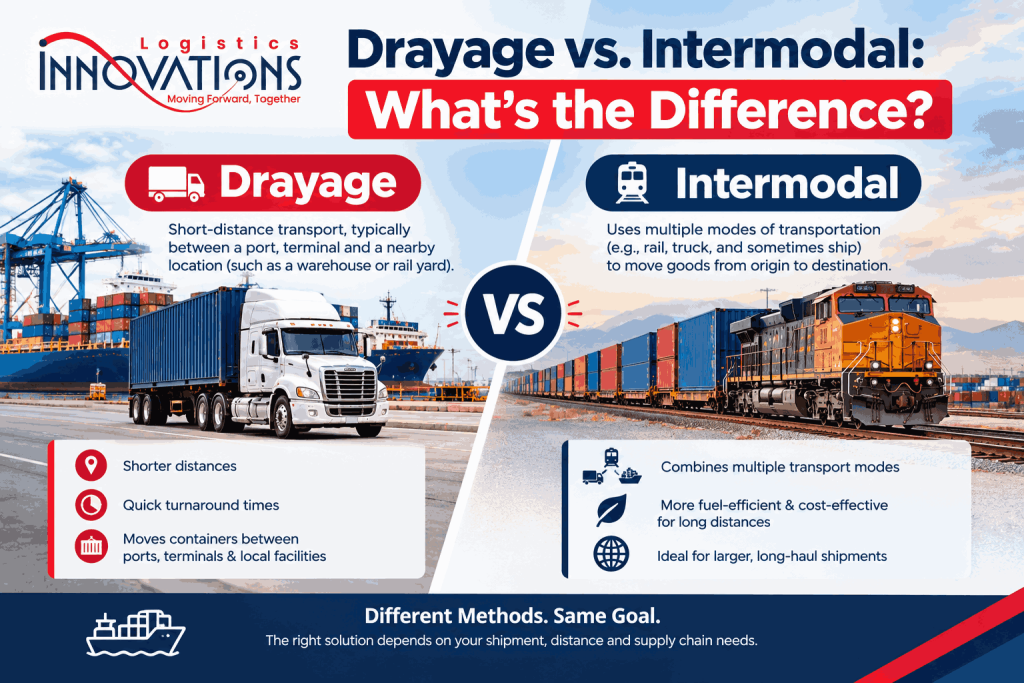
If you ship freight in or out of Canada, you’ve probably heard both terms used, sometimes interchangeably. But drayage and intermodal transportation describe two different parts of the same supply chain. Drayage is the short truck move that gets a container from a port or rail yard to its next stop. Intermodal is the full journey, using two or more transport modes (ship, rail, and truck) to move that same container across long distances. Understanding the difference between drayage and intermodal helps Canadian businesses plan realistic timelines, avoid surprise fees, and choose the right freight partner for each leg of the trip.
What Is Drayage?
Drayage is short-distance trucking, typically under 100 kilometres, that connects two points in a supply chain. Think of a container arriving at the Port of Vancouver and needing to reach a nearby rail terminal, warehouse, or distribution centre. That move is drayage.
Common drayage moves in Canada include:
- Port to rail yard (for example, Deltaport to CN’s intermodal terminal)
- Rail yard to warehouse or distribution centre
- Port to a bonded facility for customs clearance
- Empty container returns to the shipping line
Drayage uses a single mode, truck, and a single sealed container. It’s fast to arrange, flexible on scheduling, and often the piece businesses notice most because it’s the last step before their goods actually arrive.
What Is Intermodal Transportation?
Intermodal transportation refers to moving freight using multiple modes, usually ocean, rail, and truck, without unloading the goods from the container at each transfer point. A shipment might leave a factory in Asia by ship, arrive at the Port of Prince Rupert, travel by rail across the country, then finish the last few kilometres by truck.
The advantage of intermodal shipping is scale. Rail can move a large volume of containers over long distances more efficiently than trucking the entire route, which matters for Canadian importers moving goods from West Coast ports to Toronto, Montreal, or Chicago-area distribution hubs.
Drayage vs Intermodal: Key Differences
Here’s a quick breakdown of drayage vs intermodal freight side by side:
Feature | Drayage | Intermodal |
Distance | Short, usually local | Long, often coast to coast |
Modes used | Truck only | Ship, rail, and truck combined |
Typical role | First or last mile connector | Full multi-leg shipment |
Booking | Simple, often same-day | Requires coordinated scheduling |
Cost driver | Distance and wait times at terminals | Volume, rail capacity, fuel surcharges |
The easiest way to remember it: drayage is one link in the chain, intermodal is the whole chain.
How Drayage and Intermodal Work Together
In practice, these two services aren’t competitors. They’re partners. A typical import move for a Canadian business might look like this:
- Container arrives at the Port of Vancouver or Prince Rupert by ship.
- Drayage trucks move the container from the port to a CN or CP rail terminal.
- The container travels by rail (the intermodal leg) toward Calgary, Winnipeg, Toronto, or Montreal.
- Drayage trucks pick the container up from the destination rail yard and deliver it to the final warehouse.
This is why a single shipment can involve both terms without contradiction. Intermodal handles the long haul efficiently, and drayage bridges the gaps at each end. For cross-border freight moving between Canada and the US, drayage often also connects to bonded facilities where goods clear customs before continuing.
Which One Does Your Business Need?
Most businesses don’t choose one over the other. They need drayage for local movement and intermodal for the long-distance portion. That said, here’s how to think about it:
Drayage makes sense when:
- You’re moving a container a short distance between a port, rail yard, or warehouse.
- You need fast turnaround to avoid demurrage or storage fees.
- Your shipment is already at a Canadian terminal and needs local delivery.
Intermodal makes sense when:
- Your freight is travelling long distances across provinces or countries.
- You’re prioritizing cost efficiency over speed for high-volume shipments.
- You want to reduce highway trucking miles and associated fuel costs.
Many importers and exporters end up using both within the same shipment, which is why working with a provider that offers coordinated drayage and intermodal services saves time and reduces the number of vendors you need to manage.
Cost Factors to Consider in Canada
A few things affect pricing on both sides:
- Free time at terminals. Ports and rail yards typically allow a few free days before charging storage. Booking drayage promptly avoids these fees.
- Fuel surcharges. Both drayage and intermodal rates fluctuate with diesel prices.
- Distance and rail access. Businesses closer to major rail terminals in Vancouver, Calgary, Toronto, or Montreal generally pay less for the drayage leg.
- Peak season demand. Import volume spikes ahead of the holiday season can raise both trucking and rail capacity costs.
- Customs and bonded handling. Shipments requiring bonded storage or clearance add time and cost to the drayage portion.
Frequently Asked Questions
Is drayage part of intermodal shipping?
Yes. Drayage is typically the first or last leg of an intermodal shipment, connecting the port or rail terminal to the final destination.
Which is cheaper, drayage or intermodal?
Drayage tends to have a higher cost per kilometre because it covers short distances with fixed handling fees. Intermodal is generally more cost-effective per kilometre over long distances because rail spreads the cost across a larger volume.
Can a shipment use only drayage without intermodal?
Yes. If a container only needs to move locally, for example from a port straight to a nearby warehouse, that’s a drayage-only move with no rail or ocean leg involved.
How long does drayage take compared to intermodal?
Drayage moves usually happen within a day or two, depending on terminal availability. Intermodal shipments across Canada can take several days to a week or more, depending on the route and rail schedule.
Do I need separate providers for drayage and intermodal?
Not necessarily. Many Canadian logistics providers offer both drayage and intermodal service together, which simplifies scheduling and reduces the risk of delays between handoffs.
Final Thoughts
Understanding drayage vs intermodal isn’t just useful terminology, it directly affects how you plan shipments, budget for freight, and choose partners. Drayage keeps the local connections moving quickly, while intermodal handles the heavy lifting over long distances. For most Canadian importers and exporters, the real advantage comes from having both working together under one coordinated plan rather than juggling separate vendors for each leg.
If you’re trying to figure out the right mix of drayage and intermodal service for your shipments, our team at Innovations Logistics can walk you through it based on where your freight is coming from and where it needs to go. Get in touch for a free quote, and we’ll help you build a shipping plan that actually fits your supply chain.