
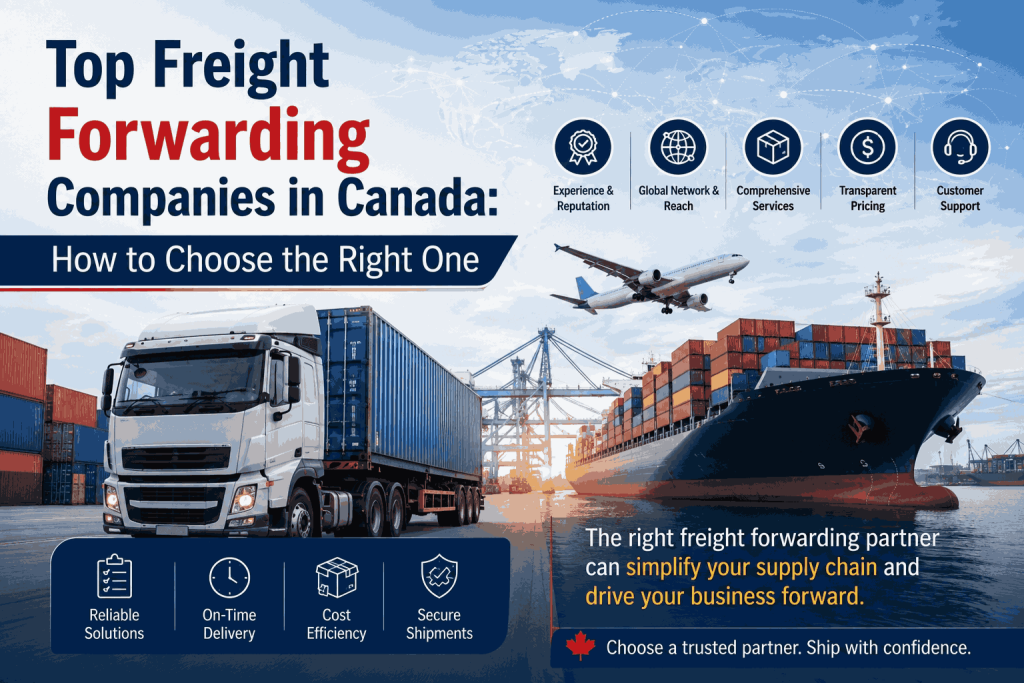
Finding the right freight forwarding companies in Canada can make a major difference to your shipping costs, delivery times, and customer service. A good freight forwarder does more than book transportation. It can coordinate ocean, air, road, and rail transport, customs, documentation, warehousing, and final delivery.
For Canadian importers, exporters, manufacturers, retailers, and growing businesses, the challenge is knowing which provider actually fits the shipment. A company that works well for large international ocean shipments may not be the right choice for local drayage or cross border trucking.
This guide looks at leading freight forwarding companies serving Canada and explains what to check before choosing one.
Top Freight Forwarding Companies in Canada
There is no single freight forwarder that is best for every Canadian business. The right choice depends on your cargo, origin, destination, shipment frequency, budget, required transit time, and need for customs or warehousing.
The companies below are worth comparing when looking for freight forwarding services in Canada.
1. Innovations Logistics
Innovations Logistics is a strong option for Canadian businesses that need freight movement combined with ground transportation and container related services.
The company provides ground freight forwarding services, drayage, warehousing and distribution, bonded shipments, intermodal services, container storage, air freight, and ocean freight. Its website also highlights shipment tracking and logistics support across Canada.
For businesses moving containers through Canadian ports, the combination of drayage, intermodal transportation, warehousing, and container services can be particularly useful. This can reduce the need to coordinate several separate logistics providers.
Best suited for: Canadian businesses needing ground freight, drayage, intermodal transportation, warehousing, container services, and broader freight support.
If you are comparing providers for your next shipment, you can review the Innovations Logistics services available across its logistics network.
2. Livingston International
Livingston International is a major Canadian logistics and customs provider with strong expertise in customs brokerage, trade compliance, and freight forwarding.
Livingston offers global forwarding by air, sea, rail, truck, and intermodal transportation. Its freight forwarding service also supports smaller businesses with shipment consolidation, documentation, tracking, and coordination with customs services.
Its Canadian operation is especially relevant for companies that want customs brokerage and freight forwarding under one provider. Livingston also maintains Canadian service locations at key border points, seaports, airports, and other logistics locations.
Best suited for: Importers and exporters that need strong customs, trade compliance, and freight forwarding support.
3. DHL Global Forwarding
DHL Global Forwarding Canada is part of DHL’s international freight network and provides air, ocean, rail, road, multimodal, and customs services in Canada.
DHL Global Forwarding supports both full container and less than container load ocean shipments, air freight, rail freight, road transportation, and customs services. Its Canadian platform also provides digital tools for quotes, bookings, shipment tracking, documents, and analytics.
For companies shipping internationally on established trade lanes, a large global network can be an important advantage. DHL also provides multimodal options for businesses looking to balance transit time and transportation costs.
Best suited for: Businesses with international shipping requirements, regular global trade lanes, and complex multimodal shipments.
4. Kuehne+Nagel
Kuehne+Nagel Canada provides international freight forwarding and supply chain services to Canadian businesses.
Its Canadian platform covers sea, air, and road logistics and provides online tools for quotes, bookings, and shipment management.
Kuehne+Nagel can be a good fit for businesses with international supply chains that need access to multiple transportation modes. The company also offers specialized logistics services for industries with specific cargo requirements.
Best suited for: Manufacturers, importers, exporters, and larger businesses with international supply chain needs.
5. DSV
DSV Canada operates freight forwarding and logistics services in Canada through its air and sea, road, and logistics divisions.
DSV’s Canadian operations include air freight, ocean freight, road transportation, and logistics services. Its Canadian terms specifically cover freight forwarding services, including air and ocean transportation.
DSV also has experience with specialized shipments, including temperature controlled, oversized, and project cargo.
Best suited for: Businesses with international freight, specialized cargo, project shipments, and multimodal transportation needs.
What Does a Freight Forwarder Do?
A freight forwarder acts as a coordinator between the shipper and transportation providers. Instead of arranging every part of a shipment yourself, you work with one logistics partner that coordinates carriers, documentation, routing, and other services.
Depending on the provider, freight forwarding may include:
- Ocean freight
- Air freight
- Road freight
- Rail and intermodal transportation
- Full container load shipping
- Less than container load shipping
- Customs clearance
- Freight documentation
- Cargo insurance
- Warehousing
- Transloading
- Drayage
- Shipment tracking
- Final mile delivery
The exact services vary by company, so it is important to ask what the quoted price actually includes.
How to Choose the Right Freight Forwarding Companies in Canada
Choosing between freight forwarders should not be based only on the lowest quote. A low transportation rate can become expensive if it excludes customs charges, terminal fees, storage, documentation, or final delivery.
Use these factors when comparing providers.
1. Check Their Experience With Your Trade Lane
Ask whether the freight forwarder regularly handles your specific origin and destination. For example, shipping from China to Vancouver is different from shipping from Germany to Montreal or moving cargo between the United States and Alberta.
An experienced forwarder should understand:
- Canadian ports and terminals
- Border procedures
- Customs documentation
- Carrier schedules
- Rail connections
- Local trucking
- Common delays on your route
2. Compare the Full Landed Cost
Do not compare only the headline freight rate. Ask for a detailed quotation showing:
- Base freight
- Fuel charges
- Terminal charges
- Documentation fees
- Customs brokerage
- Duties and taxes
- Drayage
- Warehousing
- Delivery charges
- Potential storage or detention charges
The cheapest quote is not always the cheapest shipment.
3. Look at Transportation Modes
Your freight forwarder should recommend the mode based on the shipment rather than simply selling one service.
- Ocean freight is often suitable for large or heavy international shipments where transit time is less urgent.
- Air freight can make sense for urgent, high value, or lightweight cargo.
- Rail freight can be useful for long inland movements where cost and capacity are important.
- Truck freight is essential for domestic Canadian shipments, cross border transportation, port drayage, and final delivery.
For some shipments, combining modes can provide a better balance between price and speed.
4. Ask About Customs Support
Canadian customs requirements can create serious delays when documents or classifications are incorrect. Ask the freight forwarding agency whether it provides customs brokerage directly or works with a licensed customs broker.
You should also ask how the company handles:
- Import documentation
- Export documentation
- HS classification
- Duties and taxes
- CARM requirements
- Customs releases
- Compliance questions
- Documentation corrections
A freight forwarder with strong customs knowledge can help reduce avoidable problems.
5. Check Shipment Visibility
Good shipment tracking should tell you more than “in transit.” Ask what information you will receive and how often.
Useful visibility can include:
- Pickup confirmation
- Port arrival
- Vessel departure
- Rail departure
- Customs status
- Estimated arrival
- Delivery appointment
- Proof of delivery
Digital visibility is especially valuable for businesses that manage inventory around incoming shipments.
6. Consider Customer Service
A large freight forwarder may have an impressive international network, but your day to day contact still matters.
Ask:
- Who will manage my shipments?
- Can I contact a real person when something goes wrong?
- Is support available outside normal business hours?
- How quickly are quote requests answered?
- Who handles delays and claims?
For small and medium sized Canadian businesses, responsive service can be just as important as the transportation rate.
Freight Forwarder vs Freight Carrier
These terms are often confused.
A freight carrier physically transports the goods. This could be a trucking company, railway, airline, or ocean carrier.
A freight forwarder coordinates transportation using carriers and logistics partners.
For example, a Canadian importer might purchase goods from an overseas supplier. A freight forwarder can coordinate pickup at the supplier, ocean transportation, Canadian customs clearance, port drayage, rail transportation, and final truck delivery.
That single point of coordination can save the importer considerable time.
What Should You Ask a Freight Forwarder Before Hiring Them?
Before signing an agreement, ask these questions:
- Do you regularly handle shipments on my trade lane?
- Which transportation modes do you offer?
- Do you provide customs brokerage?
- What is included in the quoted price?
- Are terminal and documentation charges included?
- Can you arrange door to door delivery?
- How will I track my shipment?
- What happens if my shipment is delayed?
- Do you handle oversized, refrigerated, or dangerous goods if required?
- Can you provide references or relevant case experience?
The answers will help you separate experienced cargo freight forwarders from companies that simply arrange basic transportation.
Red Flags to Watch For
Price is important, but it should not be your only selection criteria.
Be cautious when a freight forwarder:
- Gives vague pricing with no breakdown
- Cannot clearly explain who handles customs
- Provides limited shipment visibility
- Takes too long to respond to basic questions
- Has no clear process for handling delays
- Has little experience with your shipping lanes
- Cannot explain its responsibilities in writing
A professional freight forwarding company should be able to clearly explain its services, pricing, responsibilities, and communication process.
Which Freight Forwarder Is Right for Your Business?
The right choice depends on what your business needs.
Business requirement | What to prioritize |
Regular international shipping | Global network and route experience |
Canada and USA freight | Cross border expertise |
Ocean imports | Port coverage and container handling |
Urgent cargo | Air freight capabilities |
Multiple transportation modes | Multimodal and intermodal options |
Customs intensive shipments | Strong customs support |
Warehousing needs | Integrated logistics services |
Growing business | Scalability and flexible service |
Personalized support | Dedicated account management |
For a smaller or mid sized company, a huge global network may not always be the most important factor. You may benefit more from responsive communication, flexible solutions, transparent pricing, and a logistics team that understands your shipments.
For a multinational company with complex global trade, network size, technology, specialized handling, and international coverage may carry more weight.
Final Thoughts
The best freight forwarding companies in Canada are not necessarily the biggest companies or the ones offering the lowest quote. The right provider should understand your cargo, trade lanes, delivery requirements, customs obligations, and overall supply chain.
For Canadian businesses, it is worth comparing both large international freight forwarders and Canadian logistics providers. Companies such as Innovations Logistics, Livingston International, DHL Global Forwarding, Kuehne+Nagel, and DSV offer different strengths and service models.
If your business needs Canadian ground freight forwarding, drayage, intermodal transportation, warehousing, container services, or broader freight support, choose Innovations Logistics and request a quote based on your shipment requirements.
The most useful comparison is not simply “Who has the cheapest freight rate?”
It is “Who can move my cargo reliably from origin to final destination at a clear and predictable total cost?”
FAQ About Freight Forwarding Companies in Canada
What are freight forwarding companies?
Freight forwarding companies coordinate the movement of goods between suppliers, carriers, ports, customs authorities, warehouses, and final destinations. Services can include ocean, air, road, rail, customs, warehousing, and delivery.
How much do freight forwarding services cost in Canada?
The cost depends on cargo weight and volume, origin, destination, transportation mode, fuel costs, customs requirements, shipment type, and additional services. Request a detailed quote that shows all applicable charges.
What is the difference between a freight forwarder and a shipping company?
A shipping company or carrier physically transports cargo. A freight forwarder coordinates transportation between the shipper and carriers and may also arrange customs, documentation, warehousing, and delivery.
Do freight forwarders handle Canadian customs?
Some freight forwarders provide customs brokerage while others work with separate customs brokers. Always confirm this before booking a shipment.
How do I choose the best freight forwarder in Canada?
Compare experience, trade lane coverage, transportation modes, customs support, pricing, shipment visibility, delivery options, customer service, and experience with your type of cargo. The best freight forwarder is the one that fits your actual shipping requirements rather than simply offering the lowest initial rate.