
If your Canadian business needs to move freight, you may come across both a freight broker and a freight forwarder. The two services can look similar because both help arrange transportation, but their roles are different.
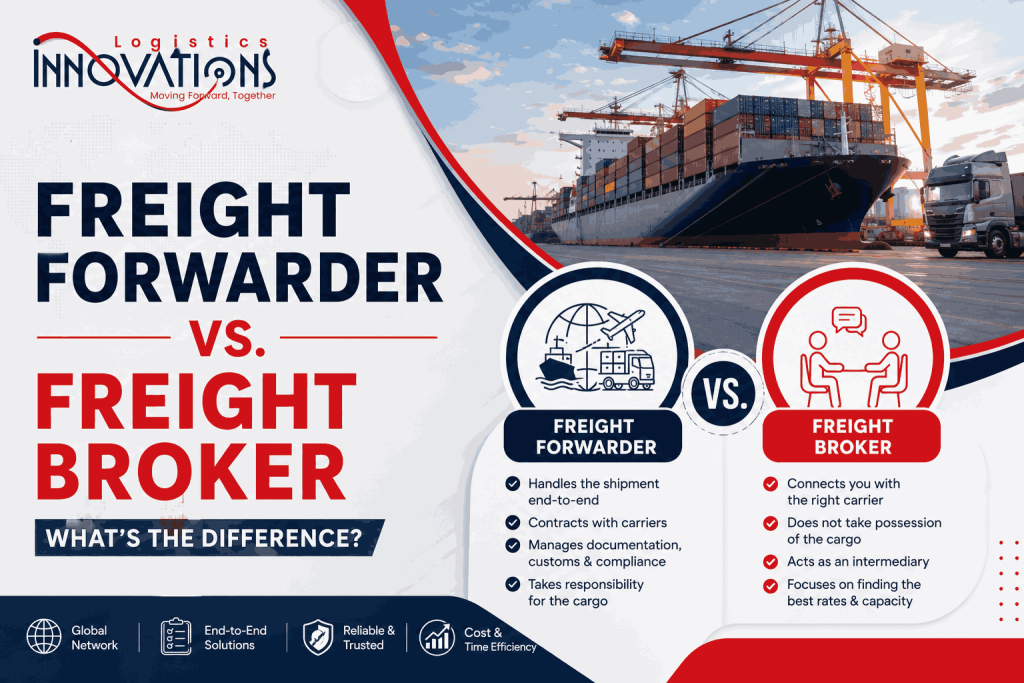
The main difference is scope. A freight broker mainly connects shippers with carriers and arranges transportation, while a freight forwarder can coordinate a broader shipment from origin to destination, including multiple transportation modes, documentation, consolidation, and other logistics services.
Knowing the difference between a freight forwarder vs freight broker can help you choose the right partner, control shipping costs, and avoid unnecessary delays.
Freight Forwarder vs Freight Broker: Quick Comparison
Here is the simplest way to understand the difference:
Factor | Freight Broker | Freight Forwarder |
Main role | Connects shippers with carriers | Coordinates the broader shipment |
Common focus | Trucking and road freight | Air, ocean, rail, truck, and multimodal freight |
Carrier network | Yes | Yes |
Shipment coordination | Yes | Yes |
International shipping | Sometimes | Common |
Cargo consolidation | Usually limited | Common |
Documentation support | Basic transportation documents | Broader shipping documentation |
Best suited for | Domestic and cross border trucking | Complex domestic and international shipments |
The exact services can vary by company. In Canada, a freight forwarder may also arrange services such as consolidation, warehousing, and customs brokerage through appropriate partners. The Canada Border Services Agency defines a freight forwarder as someone who arranges transportation of goods through one or more carriers.
What Is a Freight Broker?
A freight broker acts as an intermediary between a shipper and a transportation carrier.
For example, a Canadian manufacturer may have a full truckload moving from Calgary to Toronto. Instead of contacting multiple trucking companies to find equipment and negotiate rates, the business can work with a freight broker.
The broker can:
- Find an appropriate carrier.
- Compare available transportation options.
- Negotiate transportation rates.
- Coordinate pickup and delivery.
- Track the shipment.
- Communicate with the shipper and carrier.
- Help manage transportation issues.
The broker normally does not physically transport the freight. The carrier is responsible for moving the goods. This model can be useful for businesses that regularly ship LTL or FTL freight but do not want to maintain a large network of carrier relationships themselves.
When Should You Use a Freight Broker?
A freight broker can be a good fit when your shipment mainly requires road transportation.
For example:
Scenario: A wholesaler in Edmonton needs to move several pallets to a distribution centre in Ontario.
A broker can source suitable trucking capacity, arrange the shipment, provide transportation pricing, and coordinate delivery. For straightforward truckload or less than truckload shipments, this can be a practical option.
What Is a Freight Forwarder?
A freight forwarder manages and coordinates the movement of goods through one or more transportation modes.
Instead of focusing only on finding a truck, a freight forwarder may coordinate the complete logistics chain. Depending on the shipment, this can include:
- Ocean freight
- Air freight
- Rail transportation
- Truck transportation
- Intermodal transportation
- Cargo consolidation
- Shipment documentation
- Carrier coordination
- Customs related coordination
- Warehousing
- Delivery arrangements
The Canadian Revenue Agency notes that freight forwarders commonly assist with preparing and booking freight transportation and may consolidate shipments from multiple shippers. A forwarder can also act as an agent or, depending on the arrangement, assume responsibility as a carrier.
When Should You Use a Freight Forwarder?
Freight forwarding is particularly useful when your shipment has several moving parts.
For example, imagine a Canadian retailer importing products from Asia. The shipment may involve:
- Pickup from the overseas supplier
- Ocean transportation
- Port handling
- Customs coordination
- Container movement
- Rail or truck transportation
- Final delivery to a Canadian warehouse
Instead of managing each stage separately, the importer can use a freight forwarder to coordinate the logistics.
Freight Broker vs Freight Forwarder: The Main Differences
The biggest differences come down to scope, responsibility, transportation modes, and shipment complexity.
1. Scope of Service
A freight broker generally focuses on arranging transportation between a shipper and a carrier. A freight forwarder takes a broader approach and can coordinate several parts of the shipping process. This does not mean every forwarder handles every logistics service. Always confirm what is included in your quote.
2. Transportation Modes
Freight brokers are commonly associated with road transportation, including LTL and FTL shipments. Freight forwarders often work across multiple modes, including air, ocean, rail, and trucking. This makes forwarding useful for international and multimodal shipments.
3. International Shipping
For a simple Canada to USA truck shipment, a freight broker may be enough. For an international shipment involving an ocean container, port operations, inland transportation, and multiple documents, a freight forwarder may provide a better fit.
4. Shipment Coordination
A broker’s core job is finding and coordinating transportation capacity. A forwarder’s role can extend across the shipment lifecycle, from origin coordination to final delivery. This is especially useful when a shipment passes through several carriers, terminals, or transportation modes.
5. Cargo Responsibility
This area requires attention because the legal relationship can vary by contract. A broker generally arranges transportation without becoming the carrier moving the freight. A freight forwarder can sometimes assume greater responsibility for the transportation depending on how the service is structured. For this reason, businesses should review the service agreement and understand who is responsible for the cargo at each stage.
Freight Broker vs Freight Forwarder: Which Is Better for Canadian Businesses?
There is no universal winner. The right option depends on your shipment.
Choose a freight broker when:
- You mainly ship by truck.
- Your shipment is domestic or a straightforward Canada to USA movement.
- You need access to additional carrier capacity.
- You regularly ship LTL or FTL freight.
- You want someone to manage carrier sourcing and transportation coordination.
Choose a freight forwarder when:
- You import or export internationally.
- Your shipment uses multiple transportation modes.
- You need ocean or air freight.
- Your cargo requires consolidation.
- Your shipment involves several logistics stages.
- You want one provider coordinating a more complex movement.
For businesses with a combination of transportation needs, a logistics provider may offer both brokerage and forwarding related solutions.
Freight Forwarder vs Broker: A Canadian Example
Consider two Canadian businesses.
Business A: A manufacturer in Calgary ships full truckloads to customers in Vancouver and Winnipeg. Its main requirement is dependable road transportation. A freight broker may be suitable because the business needs carrier capacity, rate coordination, and shipment tracking.
Business B: A retailer imports containerized products from China and distributes them across Canada. Its shipment may require ocean freight, port handling, container transportation, rail, trucking, documentation, and warehouse coordination. A freight forwarder is likely a better fit because the shipment involves multiple logistics stages.
The important point is not simply choosing a broker or forwarder. It is matching the logistics model to the actual movement of your freight.
How to Choose the Right Freight Partner
Before hiring a freight broker or freight forwarder, ask these questions:
- What transportation modes do you handle?
- Do you provide domestic and cross border shipping?
- What carriers or logistics partners will handle my shipment?
- What services are included in the quoted price?
- Who handles documentation and customs coordination?
- How is shipment tracking provided?
- Who is responsible if freight is delayed or damaged?
- Can you handle recurring shipments as my volume grows?
Do not compare providers only by the lowest quote. A cheaper rate can become expensive if communication is poor, services are excluded, or delays create additional costs.
Freight Forwarding Services for Canadian Businesses
If your business needs broader transportation coordination, Innovations Logistics freight forwarding services can support domestic, cross border, and international freight through air, ocean, rail, and truck transportation. The service includes transportation planning, carrier coordination, shipment tracking, and documentation support.
The key is to explain your shipment clearly before requesting a quote. Provide the origin, destination, cargo type, dimensions, weight, shipping frequency, required delivery date, and any special handling or customs requirements. This gives the logistics provider enough information to recommend an appropriate transportation solution.
Frequently Asked Questions
1: Is a freight broker the same as a freight forwarder?
No. A freight broker primarily arranges transportation by connecting shippers with carriers. A freight forwarder can coordinate a broader shipment and may manage multiple transportation modes and logistics activities.
2: Is a freight broker cheaper than a freight forwarder?
Not always. Pricing depends on shipment size, distance, transportation mode, route, service requirements, and market conditions. A broker may be more suitable for straightforward trucking, while a forwarder can provide better value for complex shipments.
3: Do freight brokers own trucks?
Generally, no. Freight brokers arrange transportation through carriers rather than physically transporting the freight themselves.
4: Can a freight forwarder handle Canada to USA shipping?
Yes. Freight forwarders can coordinate cross border transportation, particularly when a shipment requires multiple logistics services. The exact services offered vary by provider.
5: Should I use a freight broker or freight forwarder?
If you mainly need domestic or cross border trucking, a freight broker may be appropriate. If your shipment involves international transportation, multiple modes, consolidation, or more complex coordination, a freight forwarder may be the better choice.
Final Thoughts
The difference between a freight broker vs freight forwarder comes down mainly to the level of logistics coordination your shipment requires.
A freight broker is often a strong choice for businesses that need efficient access to trucking capacity. A freight forwarder is generally more useful when freight involves international transportation, several modes, consolidation, documentation, or multiple stages from origin to final destination.
Before choosing a provider, look beyond the quoted freight rate. Check the transportation options, carrier network, communication process, documentation support, tracking, responsibilities, and overall service scope.
If you are a Canadian business looking for help with domestic, cross border, or international freight, contact Innovations Logistics for a freight quote and discuss your shipment requirements with a logistics professional.