
Running a business in Canada means dealing with supply chain challenges that go far beyond what most companies expect. From the country’s vast geography and transportation bottlenecks to labour shortages, rising freight costs, changing customer expectations, and evolving trade policies, supply chain challenges in Canada have become more complex in recent years.
According to Statistics Canada, many Canadian industries remain highly vulnerable to external demand and supply shocks, highlighting how disruptions can quickly affect business operations and the broader economy. For businesses that rely on manufacturing, retail, ecommerce, imports, or exports, even a single disruption can lead to delayed deliveries, higher operating costs, inventory shortages, and dissatisfied customers.
The good news is that these challenges can be managed with the right strategies. Improving supply chain visibility, adopting modern technology, strengthening logistics partnerships, and planning for potential disruptions can help businesses reduce risks, improve efficiency, and build a more resilient supply chain.
In this guide, we’ll explore the biggest supply chain challenges facing Canadian businesses today and share practical solutions to help you overcome them, improve operational performance, and keep your supply chain running smoothly.
Why Supply Chain Challenges Continue to Grow in Canada
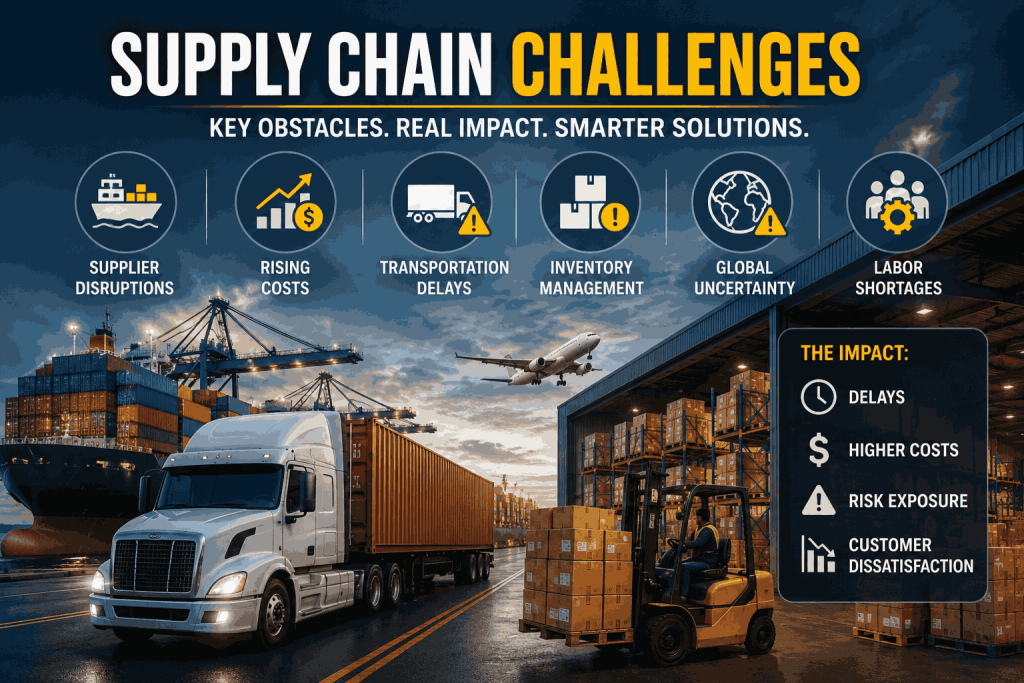
Canada’s supply chain is shaped by unique geographic, economic, and trade-related factors. Businesses move goods across vast distances while relying on complex networks of carriers, warehouses, ports, railways, and cross-border transportation. At the same time, labour shortages, rising freight costs, changing trade policies, and increasing customer expectations have made supply chain challenges in Canada more difficult to manage than ever.
Many Canadian businesses also depend on suppliers and customers in the United States and other global markets. As a result, disruptions such as transportation delays, customs issues, supplier shortages, or shifts in trade regulations can quickly affect inventory levels, operating costs, production schedules, and customer deliveries.
The challenge is rarely a single issue. Instead, multiple supply chain management challenges often occur at the same time, creating a ripple effect across the entire logistics network. Businesses that improve visibility, diversify suppliers, adopt modern technology, and strengthen logistics partnerships are better positioned to reduce risks and maintain efficient operations.
Top Supply Chain Challenges Facing Canadian Businesses
1. Transportation Delays
Transportation delays remain one of the biggest supply chain challenges in Canada. Freight can be delayed by port congestion, rail disruptions, limited trucking capacity, border inspections, highway closures, or severe winter weather. Even a short delay can disrupt production schedules, create inventory shortages, and postpone customer deliveries.
How businesses can reduce transportation delays
- Plan shipments well in advance, especially during peak seasons.
- Diversify transportation modes, including trucking, rail, and intermodal shipping.
- Monitor shipments with real-time tracking systems.
- Build realistic delivery schedules with contingency plans.
- Partner with experienced logistics providers that offer end-to-end visibility.
2. Rising Transportation and Freight Costs
Increasing fuel prices, labour expenses, equipment costs, insurance, and warehousing fees continue to drive up transportation costs across Canada. These higher logistics expenses put pressure on profit margins and make cost control a priority for businesses.
How businesses can reduce freight costs
- Consolidate shipments whenever possible.
- Optimize transportation routes.
- Reduce empty return trips.
- Use strategically located warehouses.
- Analyze freight data regularly to identify cost-saving opportunities.
- Consider intermodal transportation for long-distance freight.
3. Labour Shortages Across the Supply Chain
Labour shortages continue to affect trucking companies, warehouses, manufacturing facilities, ports, and distribution centres. A shortage of skilled drivers, warehouse staff, and logistics professionals can slow operations, increase labour costs, and reduce overall efficiency.
How businesses can address labour shortages
- Invest in warehouse automation where practical.
- Improve employee training and retention.
- Use warehouse and transportation management systems.
- Partner with third-party logistics (3PL) providers during periods of high demand.
- Improve workforce planning and scheduling.
4. Inventory Management Challenges
Maintaining the right inventory levels remains a significant challenge. Excess inventory ties up capital and increases storage costs, while insufficient inventory can lead to stockouts, lost sales, and dissatisfied customers.
Best practices for inventory management
- Use demand forecasting tools.
- Monitor inventory in real time.
- Analyze historical sales trends.
- Maintain appropriate safety stock.
- Improve communication between purchasing, warehousing, and transportation teams.
5. Limited Supply Chain Visibility
Without accurate, real-time information, businesses often struggle to identify delays, monitor shipments, or make informed operational decisions. Limited visibility can increase costs, reduce efficiency, and negatively affect customer service.
How to improve supply chain visibility
- Implement shipment tracking technology.
- Integrate inventory, transportation, and warehouse management systems.
- Monitor key performance indicators (KPIs).
- Use cloud-based logistics platforms for real-time data sharing.
- Work with logistics partners that provide end-to-end visibility across the supply chain.
6. Supplier Disruptions
Many Canadian businesses rely on suppliers across multiple provinces and international markets. Production delays, transportation disruptions, raw material shortages, or geopolitical events can interrupt supply and affect business operations.
How to reduce supplier risk
- Diversify your supplier base.
- Regularly evaluate supplier performance.
- Build long-term relationships with key suppliers.
- Develop contingency sourcing plans.
- Share demand forecasts to improve planning and collaboration.
7. Increasing Customer Expectations
Customers expect faster delivery, accurate tracking, and reliable service. Businesses that cannot consistently meet these expectations risk losing customers to competitors.
Ways to improve customer satisfaction
- Provide real-time shipment tracking.
- Communicate proactively during delays.
- Optimize delivery routes.
- Position inventory closer to customers.
- Work with reliable transportation and logistics partners.
8. Technology Integration Challenges
Many organizations still use disconnected systems for inventory, transportation, purchasing, and warehouse management. These silos increase manual work, create data inconsistencies, and slow decision-making.
Best practices for technology integration
- Connect inventory and transportation systems.
- Adopt cloud-based logistics software.
- Automate routine processes and reporting.
- Track operational performance using KPIs.
- Review business data regularly to support continuous improvement.
9. Managing Risk and Business Continuity
Unexpected disruptions, including severe weather, transportation interruptions, labour disputes, supplier failures, and global events, can impact supply chain operations at any time.
Businesses with strong risk management and business continuity plans are better prepared to respond quickly, minimize disruptions, and maintain service levels during challenging conditions.
How Canadian Businesses Can Build a More Resilient Supply Chain
There is no single solution to every supply chain challenge. The most successful businesses focus on continuous improvement, proactive planning, and building flexibility into every stage of their operations.
Key strategies include:
- Improving demand forecasting and inventory planning.
- Diversifying suppliers to reduce dependency on a single source.
- Increasing real-time visibility across shipments and inventory.
- Optimizing transportation routes to control freight costs.
- Investing in modern supply chain technology and automation.
- Developing contingency plans for unexpected disruptions.
- Partnering with experienced logistics providers that can scale with your business.
When these strategies work together, businesses become more resilient, improve operational efficiency, reduce costs, and deliver a better customer experience even during periods of disruption.
Why the Right Logistics Partner Makes a Difference
As businesses grow, managing transportation, warehousing, inventory, customs coordination, and freight operations internally can become increasingly complex.
An experienced logistics partner can help you:
- Improve end-to-end supply chain visibility.
- Reduce transportation and warehousing costs.
- Coordinate multiple shipping modes more efficiently.
- Minimize delays and supply chain disruptions.
- Improve inventory flow and operational planning.
- Scale logistics operations during seasonal demand or business growth.
By combining transportation, warehousing, and supply chain services under one provider, businesses can simplify operations, improve efficiency, and build a more reliable supply chain for the future. At Innovation Logistics, we help businesses across Canada manage transportation, warehousing, and supply chain operations through integrated logistics solutions designed to improve efficiency, reduce costs, and keep freight moving reliably.
Final Thoughts
Supply chain challenges in Canada are constantly evolving, but they can be managed with the right strategy, technology, and partnerships. Businesses that invest in visibility, strengthen supplier relationships, improve inventory management, and adopt flexible logistics solutions are better equipped to navigate disruptions and remain competitive.
Rather than reacting to problems as they arise, focus on building a resilient supply chain that supports long-term growth, improves customer satisfaction, and positions your business for continued success.
Frequently Asked Questions
What are the biggest supply chain challenges in Canada?
Some of the most common supply chain challenges in Canada include transportation delays, rising freight costs, labour shortages, supplier disruptions, inventory management issues, limited supply chain visibility, and increasing customer expectations.
How can businesses reduce supply chain issues?
Businesses can reduce supply chain issues by improving demand forecasting, optimizing inventory management, diversifying suppliers, using real-time shipment tracking, investing in modern technology, and partnering with experienced logistics providers.
Why is supply chain visibility important?
Supply chain visibility enables businesses to monitor shipments, track inventory in real time, identify disruptions early, improve customer communication, and make faster, data-driven decisions.
What causes supply chain management issues?
Supply chain management issues can result from transportation disruptions, inaccurate demand forecasting, supplier delays, labour shortages, poor communication, changing market conditions, outdated technology, and unexpected global events.
Why is inventory management important in supply chain management?
Effective inventory management helps businesses maintain the right stock levels, reduce carrying costs, prevent stockouts, improve cash flow, and meet customer demand more consistently.
How can a logistics company improve supply chain performance?
An experienced logistics company can help businesses optimize transportation, coordinate freight movements, improve warehouse operations, enhance supply chain visibility, reduce shipping costs, and increase delivery reliability through integrated logistics solutions.