
Canada’s supply chain depends on two closely connected functions: warehousing and logistics. Many businesses focus on shipping products quickly, but fast delivery is only possible when warehousing and logistics work as one system.
From inventory storage and order fulfillment to transportation and last-mile delivery, every step must be coordinated. When there is a gap between warehouse operations and logistics planning, businesses often face delayed shipments, higher costs, inventory shortages, and unhappy customers.
For Canadian businesses facing growing customer expectations, rising transportation costs, and nationwide distribution challenges, integrating warehousing and logistics operations has become essential. Companies that align these operations can improve efficiency, reduce expenses, and provide a better customer experience.
In this guide, we’ll explain how warehousing and logistics work together in Canada, why the partnership matters, and how businesses can benefit from professional warehousing and logistics services.
What Is Warehousing and Logistics, and Why Do They Overlap?
Let’s keep this simple.
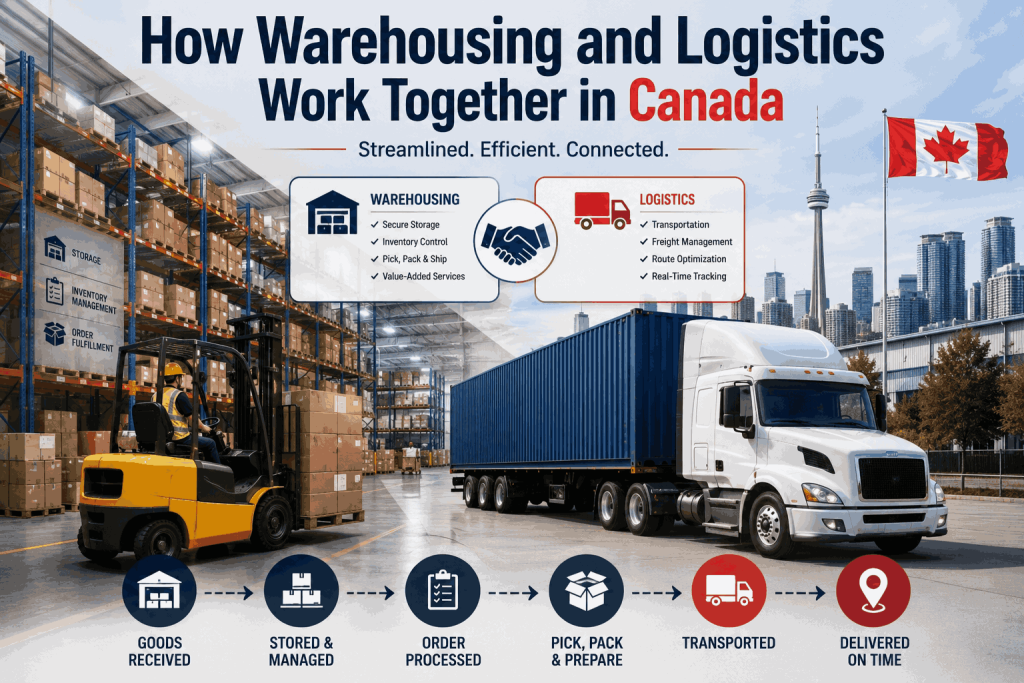
Warehousing is about storing goods. That includes receiving shipments, organizing products, managing inventory, and keeping goods safe until they’re needed. Many businesses rely on warehousing and fulfillment services to manage these tasks efficiently.
Logistics is about moving goods. That covers transportation, routing, customs clearance, order fulfillment, and delivery coordination.
On paper, they look separate. In practice, they can’t be separated. A warehouse that doesn’t communicate with the transportation team creates backlogs. A logistics provider that doesn’t have access to real-time inventory data ships the wrong product or the wrong quantity.
In Canada, where supply chains stretch across thousands of kilometres from the Port of Vancouver to the Port of Halifax, and through border crossings into the U.S., this coordination becomes even more critical.
According to a Grand View Research report, Canada’s warehousing market generated USD $59.5 billion in revenue in 2024 and is projected to reach USD $92.9 billion by 2030, growing at a CAGR of 7.7%. That growth isn’t happening in a vacuum. It’s being driven by e-commerce, cross-border trade, and businesses demanding faster, more reliable supply chain solutions.
Why Warehousing and Logistics Must Work Together
Warehousing and logistics are often viewed as separate functions, but they depend heavily on one another.
A warehouse may have products ready for shipment, but without proper logistics planning, deliveries can be delayed. Likewise, even the best transportation network cannot perform efficiently if inventory is poorly managed.
When both operations work together, businesses gain:
- Faster order processing
- Reduced transportation costs
- Better inventory visibility
- Improved customer satisfaction
- Higher operational efficiency
This connection forms the backbone of a successful supply chain.
How Warehousing and Logistics Work Together in Canada
1. Inventory Storage Supports Transportation Planning
Logistics teams need accurate inventory information before arranging shipments. Warehouse management systems provide real-time stock visibility, allowing logistics coordinators to:
- Confirm product availability
- Schedule deliveries
- Avoid stockouts
- Prevent shipping delays
For example, if a customer in Alberta places an order, warehouse staff can immediately verify inventory levels while logistics teams arrange transportation. This coordination reduces errors and keeps orders moving smoothly.
2. Order Fulfillment Depends on Logistics Coordination
Modern consumers expect fast shipping. After an order is received, warehouse teams:
- Pick the products
- Pack the order
- Prepare shipping documents
- Stage the shipment for pickup
The logistics team then:
- Assigns carriers
- Plans transportation routes
- Schedules delivery times
- Tracks shipment progress
This process is why many businesses invest in warehousing and fulfillment services that combine storage and transportation under one provider.
3. Strategic Warehouse Locations Reduce Shipping Costs
Canada’s large geographic area creates unique distribution challenges. Businesses serving customers nationwide must carefully position inventory to reduce transportation expenses.
Strategically located warehouses help:
- Shorten delivery distances
- Reduce freight costs
- Improve delivery speed
- Lower fuel consumption
Many providers offering warehousing and distribution services in Canada maintain facilities near major transportation corridors, ports, and population centers. This allows products to reach customers more efficiently across the country.
4. Real-Time Technology Connects Warehousing and Logistics
Technology has changed how supply chains operate. Modern warehouse and logistics systems share information in real time, including:
- Inventory levels
- Order status
- Shipment tracking
- Delivery updates
- Returns processing
Integrated systems help businesses:
- Improve visibility
- Reduce manual errors
- Make faster decisions
- Respond quickly to customer requests
Companies using advanced warehousing and logistics services can monitor products from storage through final delivery.
5. Distribution Networks Depend on Efficient Warehousing
Distribution centers play a major role in supply chain efficiency. Products arrive from manufacturers and are stored before being distributed to retailers, businesses, or consumers.
Effective warehousing and distribution services ensure products move quickly through the network rather than sitting idle in storage.
Benefits include:
- Reduced inventory carrying costs
- Faster order fulfillment
- Improved inventory turnover
- Better customer service
This is particularly important for e-commerce businesses that handle high order volumes.
The Role of 3PL Providers in Canada
Many companies choose to outsource warehousing and logistics operations to third-party logistics providers. These providers offer integrated solutions that combine storage, fulfillment, transportation, and distribution.
Common services include:
- Inventory management
- Order fulfillment
- Freight coordination
- Transportation management
- Reverse logistics
- Distribution planning
Using 3PL logistics services Canada allows businesses to focus on sales and growth while logistics experts handle daily supply chain operations.
Benefits of Using 3PL Warehousing Services
Reduced Operating Costs
Building and managing a warehouse requires significant investment. 3PL warehousing services eliminate many of these expenses by providing existing infrastructure and trained personnel.
Improved Scalability
Businesses often experience seasonal demand fluctuations. A 3PL provider can adjust storage space and fulfillment resources as needed.
Better Delivery Performance
Established logistics networks help businesses reach customers faster and more reliably.
Access to Technology
Many providers offer advanced inventory management and shipment tracking systems without requiring major technology investments.
The Role of Technology in Modern Warehousing and Distribution Services
The gap between a great logistics operation and a struggling one often comes down to technology. Here’s what good warehousing and distribution services Canada providers are using today:
Warehouse Management Systems (WMS)
Real-time inventory tracking, order processing, and shipping coordination all in one platform. A WMS connects your warehouse floor to your logistics team.
Transportation Management Systems (TMS)
TMS platforms help plan routes, select carriers, track shipments, and manage freight spend. When integrated with a WMS, they give you end-to-end visibility.
EDI (Electronic Data Interchange)
For businesses working with large retailers or cross-border trading partners, EDI automates the exchange of purchase orders, invoices, and shipping notices, reducing manual errors and processing time.
Barcode Scanning and RFID
Accurate product tracking from the moment goods arrive to the moment they ship. This cuts picking errors and keeps inventory counts reliable.
When these tools are in place, the handoff between warehousing and logistics becomes nearly seamless. Orders don’t get lost. Stock levels are always accurate. Carriers are booked on time.
Industries That Benefit from Warehousing and Logistics Integration
E-Commerce: Online retailers need fast fulfillment and reliable delivery to remain competitive.
Manufacturing: Manufacturers depend on timely inventory movement to maintain production schedules.
Retail: Retail businesses require efficient distribution to keep shelves stocked.
Food and Beverage: Temperature-controlled warehousing and transportation ensure product quality and compliance.
Healthcare: Medical products require secure storage and timely distribution.
These industries rely heavily on integrated logistics and warehousing services to maintain supply chain performance.
Challenges Canadian Businesses Face
Even with strong systems in place, businesses often face logistics challenges.
Geographic Size: Canada’s vast landscape creates longer shipping routes and higher transportation costs.
Seasonal Weather: Winter storms and severe weather can impact delivery schedules.
Inventory Accuracy: Poor inventory management can create delays and fulfillment errors.
Rising Transportation Costs: Fuel prices and labor costs continue to affect logistics expenses.
Working with experienced providers offering warehousing and distribution services can help businesses address these challenges more effectively.
What to Look for in a Warehousing and Logistics Partner
Not all providers are built the same. When you’re evaluating logistics services in Canada, here’s what matters:
- Location of facilities: Are they near your key ports, suppliers, or customers? Proximity to the Canada-U.S. border matters for importers and exporters.
- Range of services: Do they offer both warehousing and fulfillment, or just one? An integrated provider reduces handoffs and communication gaps.
- Customs experience: Cross-border shipping involves CBSA compliance, tariff classification, and documentation. Make sure your partner knows Canadian customs requirements.
- Scalability: Can they handle your peak season volume without degrading service?
- Technology: Do they have the systems to give you real-time visibility into your inventory and shipments?
- Track record: Ask for references from businesses with similar shipping profiles.
If you’re importing goods into Canada or distributing across the country, working with a provider that understands both the warehousing and logistics sides of the equation saves time and prevents costly mistakes.
Innovations Logistics works with Canadian businesses to provide end-to-end warehousing and logistics services from customs clearance and storage to distribution and last-mile delivery.
FAQ: Warehousing and Logistics in Canada
What is the difference between warehousing and logistics?
Warehousing focuses on storing and managing inventory, while logistics involves transporting products through the supply chain. Both functions work together to ensure efficient product movement.
Why are warehousing and logistics important for Canadian businesses?
They help businesses improve inventory control, reduce costs, speed up deliveries, and provide better customer service across Canada’s large geographic area.
What are warehousing and fulfillment services?
These services include inventory storage, order processing, picking, packing, and shipping products directly to customers.
What are 3PL logistics services in Canada?
Third-party logistics providers manage warehousing, fulfillment, transportation, and distribution on behalf of businesses.
How do warehousing and distribution services improve efficiency?
They position inventory strategically, reduce shipping distances, improve delivery times, and streamline supply chain operations.
Conclusion
Successful supply chains depend on strong coordination between warehousing and logistics. Warehousing ensures products are stored, managed, and prepared for shipment, while logistics moves those products efficiently to their destination.
When these operations work together, businesses can reduce costs, improve delivery performance, maintain inventory accuracy, and provide a better customer experience.
As customer expectations continue to grow across Canada, integrated warehousing and logistics services are becoming a key competitive advantage. Businesses that invest in efficient storage, fulfillment, transportation, and distribution systems are better positioned for long-term growth.
If you’re looking to improve your supply chain performance, partnering with an experienced provider like Innovation logistics, offering warehousing, fulfillment, and logistics support can help your business operate more efficiently and serve customers more effectively across Canada.