
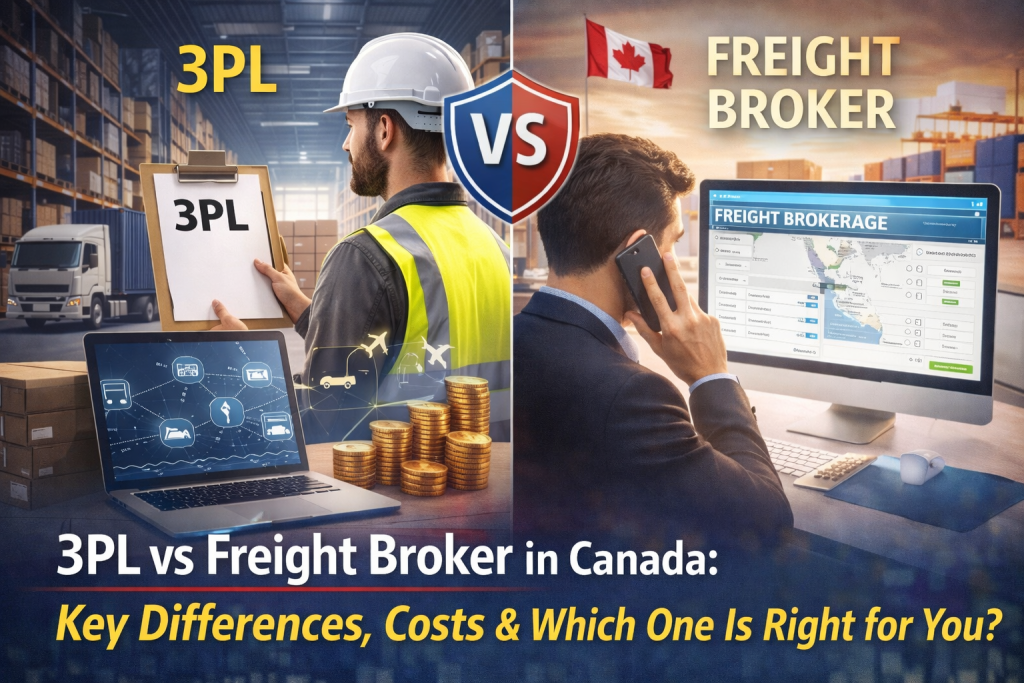
If you’re shipping goods across Canada or cross-border into the U.S., you’ve probably come across two terms that get mixed up all the time: 3PL vs freight broker. Both can move your cargo. Both can save you money. But they are not the same thing, and choosing the wrong one can cost your business time, money, and customer trust.
Whether you’re a small e-commerce brand in Toronto, a manufacturer in Ontario, or a growing retailer looking to scale your supply chain, this guide breaks down exactly what separates a freight broker from a 3PL logistics provider and which one actually fits your needs.
What Is a Freight Broker?
A freight broker is a licensed intermediary that connects shippers (businesses that need to move goods) with carriers (trucking companies, railroads, air freight companies, etc.). They don’t own trucks or warehouses. They negotiate on your behalf and arrange the transportation.
In Canada, freight brokers must comply with regulations from the Canadian Transportation Agency (CTA) and work within provincial and federal guidelines. A freight broker in Ontario or a freight broker in Toronto, for example, often specializes in cross-border Canada-U.S. shipments, LTL (less-than-truckload), or FTL (full truckload) lane optimization.
What a freight broker typically does:
Service | Description |
Carrier sourcing | Finds and vets trucking or shipping carriers on your behalf |
Rate negotiation | Leverages carrier relationships to get competitive freight rates |
Load matching | Matches your shipment to available capacity in the market |
Documentation support | Helps with bills of lading, customs paperwork, and compliance |
Shipment tracking | Provides visibility into your load’s movement from pickup to delivery |
A freight broker earns a commission or margin on the difference between what the carrier charges and what you pay. They’re ideal when your primary need is moving freight from Point A to Point B at a good price.
What Is 3PL Logistics?
3PL stands for third-party logistics. A 3PL provider is a company that manages a broader range of supply chain functions on your behalf, not just transportation, but also warehousing services, inventory management, order fulfillment, returns processing, and more.
3PL logistics meaning in practical terms: it’s like outsourcing your entire back-end logistics operation to a specialized partner. Instead of running your own warehouse and managing your own fleet, a 3PL does it for you.
In Canada, 3PL logistics providers are particularly popular among e-commerce companies, importers, and businesses looking to scale without investing in physical infrastructure. Cities like Toronto and the Greater Toronto Area (GTA) are major hubs for 3PL logistics in Canada, given their proximity to major U.S. border crossings, ports, and rail networks.
What a 3PL provider typically manages:
Service | Description |
Warehousing & storage | Physical space to store your inventory across Canada |
Order fulfillment | Picking, packing, and shipping customer orders on your behalf |
Inventory management | Real-time tracking of stock levels, SKUs, and reorder points |
Transportation management | Coordinating carriers, routes, and freight across all modes |
Returns management | Handling reverse logistics and restocking returned goods |
Customs & compliance | Managing import/export documentation for cross-border shipments |
Technology integration | Connecting your e-commerce store or ERP to their logistics systems |
A 3PL in Canada, like Innovations Logistics, offers end-to-end supply chain solutions that go far beyond just booking a truck, they become a strategic extension of your operations.
3PL vs Freight Broker: Side-by-Side Comparison
Here’s a clear breakdown of how the two differ across the most important factors:
Factor | Freight Broker | 3PL Provider |
Core function | Arranges transportation only | Manages full or partial supply chain |
Owns assets? | No (asset-free middleman) | Often yes (warehouses, tech, sometimes fleet) |
Warehousing | Not included | Core service offering |
Order fulfillment | Not included | Typically included |
Best for | Businesses that only need freight moved | Businesses that need storage + shipping + logistics |
Contract length | Usually per-shipment or short-term | Usually longer-term partnerships |
Technology | Basic TMS or load board access | Full WMS, TMS, and ERP integrations |
Cost structure | Per-load commission or margin | Monthly/variable fees based on volume and services |
Scalability | Limited to transport arrangements | Scales with your entire supply chain |
Customs support | Basic | Comprehensive (especially cross-border) |
When Should You Use a Freight Broker in Canada?
A freight broker makes the most sense when your logistics needs are primarily transportation-focused. Consider a freight broker if:
- You already have your own warehouse or fulfillment setup and just need reliable carriers to move freight.
- You’re shipping large volumes of goods (FTL loads) on consistent lanes across Canada or into the U.S.
- You need to move a one-off or seasonal shipment without committing to a long-term logistics partner.
- You want access to a wide carrier network without managing those relationships yourself.
- You’re dealing with spot market rates and need someone who can quickly find capacity.
Example: A Toronto-based furniture manufacturer that ships full truckloads to retailers in Western Canada doesn’t need warehousing, they just need reliable, cost-competitive carriers. A freight broker in Toronto is a perfect fit here.
When Should You Use a 3PL Provider in Canada?
A 3PL logistics provider is the right choice when your supply chain needs go beyond just moving freight. Consider a 3PL if:
- You’re an e-commerce business that needs to store products and ship individual orders to customers across Canada.
- You’re scaling rapidly and don’t want to invest capital in warehouse space or logistics staff.
- You’re importing goods internationally and need customs support, inland transportation, and distribution.
- You want a single partner managing inventory, fulfillment, returns, and carrier relationships together.
- You’re looking to improve delivery times or reduce shipping costs through smarter logistics planning.
Example: An online health and wellness brand based in Ontario that sources products from Asia and sells to customers nationwide needs storage, pick-and-pack fulfillment, and last-mile delivery management. A 3PL in Canada, like Innovations Logistics, handles every link in that chain from receiving at the warehouse to the package at your customer’s door.
Cost Comparison: 3PL vs Freight Broker
Cost is always a top concern. Here’s a realistic breakdown:
Freight Broker Costs
Cost Element | Typical Range |
Broker margin on freight | 10%–20% above carrier cost |
Per-load fee (if flat fee model) | $100–$500 depending on load type |
Freight brokers generally have lower upfront costs since you’re only paying for transportation. However, you still carry the cost of warehousing elsewhere.
3PL Provider Costs
Cost Element | Typical Range |
Receiving fee | $25–$75 per pallet |
Monthly storage | $10–$25 per pallet/month |
Pick and pack | $2–$5 per order |
Outbound shipping | Variable (carrier rate + handling) |
Setup/onboarding fee | $0–$500 depending on provider |
A 3PL involves more line items, but when you factor in the cost of running your own warehouse (rent, staff, equipment, software), the total cost of ownership often favors outsourcing, especially for businesses shipping 200+ orders per month.
Can a 3PL Also Act as a Freight Broker?
Yes, and many do. A full-service 3PL logistics company in Canada typically has in-house freight brokerage capabilities, meaning they can source and negotiate carriers on your behalf as part of a broader service package.
This is actually one of the biggest advantages of working with a comprehensive 3PL provider like Innovations Logistics. You get the benefits of a freight broker (carrier access, rate negotiation) combined with the full logistics infrastructure of a 3PL, all under one roof. This eliminates the need to manage multiple vendor relationships and creates one accountable point of contact for your supply chain.
3PL vs Freight Broker: Which One Is Right for Your Business?
Use this quick decision guide:
Your Situation | Best Choice |
You only need to move freight, no storage needed | Freight Broker |
You need to store, fulfill, and ship orders | 3PL Provider |
You’re an e-commerce business | 3PL Provider |
You ship FTL loads on regular lanes | Freight Broker |
You’re scaling fast and want one logistics partner | 3PL Provider |
You need cross-border Canada–U.S. logistics | 3PL Provider (with brokerage capability) |
You need a one-time or spot shipment | Freight Broker |
You want full supply chain visibility | 3PL Provider |
If you’re still not sure, the honest answer is this: most growing businesses eventually outgrow a freight broker relationship and move to a 3PL. The earlier you make that shift strategically, the smoother your growth will be.
Frequently Asked Questions (FAQ)
Q1: What is the main difference between a 3PL and a freight broker?
A freight broker arranges transportation between shippers and carriers, acting as a middleman without owning any assets. A 3PL (third-party logistics) provider offers a broader set of services, including warehousing, order fulfillment, inventory management, and transportation, essentially managing all or part of your supply chain on your behalf.
Q2: Do I need a licensed freight broker in Canada?
Yes. In Canada, freight brokers operating in regulated transportation sectors must comply with guidelines from the Canadian Transportation Agency (CTA). Cross-border freight into the U.S. may also require compliance with FMCSA (Federal Motor Carrier Safety Administration) regulations. Always verify your broker’s credentials and licensing before engaging.
Q3: How much does a 3PL cost in Canada?
3PL costs in Canada vary based on the services you need, your shipment volume, and the provider. Typical costs include receiving fees ($25–$75/pallet), storage ($10–$25/pallet/month), pick-and-pack ($2–$5/order), and outbound shipping. Many providers offer custom pricing for high-volume clients.
Q4: Can a small business in Canada benefit from 3PL services?
Absolutely. Many 3PL providers in Canada work with small and medium-sized businesses. The key advantage for smaller businesses is that you only pay for what you use you don’t need to commit to a long-term warehouse lease or hire logistics staff. As your volume grows, your 3PL scales with you.
Q5: Is a freight broker or 3PL better for cross-border Canada–U.S. shipping?
For straightforward cross-border FTL or LTL shipments, a knowledgeable freight broker in Ontario or Toronto with cross-border expertise can work well. However, if you need warehousing on either side of the border, customs management, duty drawback, or distribution into the U.S., a 3PL with cross-border capabilities is the stronger choice. It reduces complexity and gives you one point of accountability.
Final Thoughts: Make the Right Logistics Choice for Your Business
There’s no one-size-fits-all answer in the 3PL vs freight broker debate. It depends entirely on your business needs.
- Choose a 3PL logistics Canada provider if you want end-to-end supply chain support and long-term growth.
- Choose a freight broker if you only need quick, cost-effective transportation.
At Innovations Logistics, we specialize in end-to-end 3PL logistics solutions across Canada, including warehousing, order fulfillment, cross-border shipping, and freight management. Whether you’re based in Toronto, Ontario, or anywhere across Canada, our team is ready to build a logistics solution around your business goals, not the other way around.
Ready to streamline your supply chain? Get in touch with us today and find out how our 3PL services can reduce your costs, improve delivery times, and give you the logistics infrastructure to grow with confidence.