
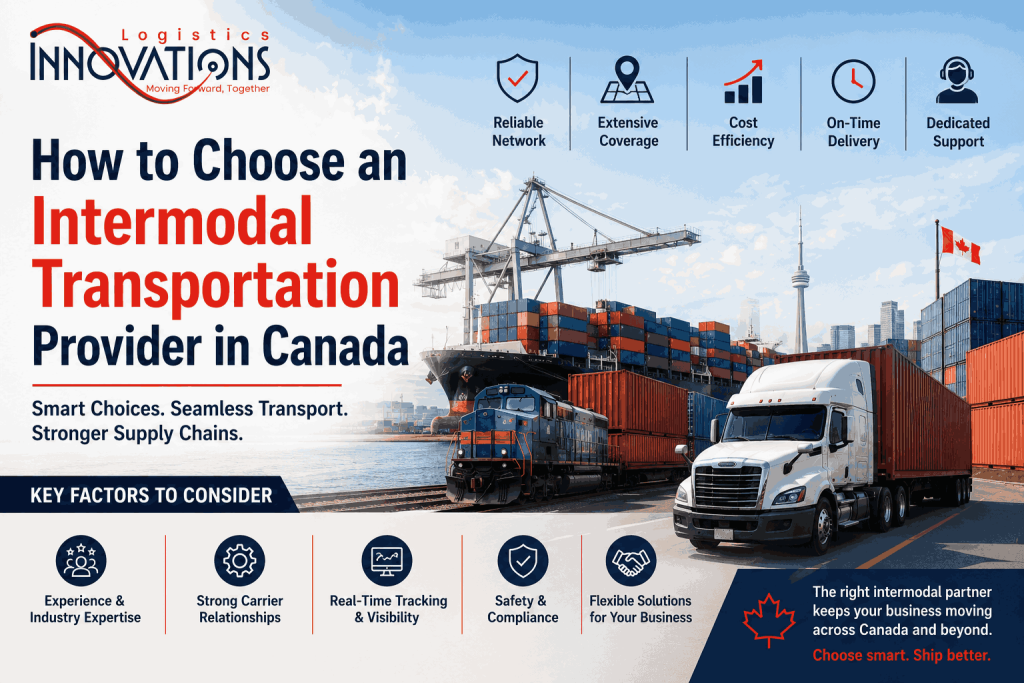
Choosing the right intermodal transportation provider in Canada can affect freight costs, delivery reliability, and your overall supply chain performance. The right provider should do more than arrange rail transportation. They should coordinate trucking, rail terminals, containers, tracking, and final delivery as one connected service.
For Canadian businesses shipping long distances, intermodal transportation can be a practical alternative to truck only freight. However, not every provider offers the same network, equipment, communication, or level of support.
Here is what to look for when comparing providers.
What Is Intermodal Transportation?
Intermodal transportation uses two or more modes, most commonly rail and truck, to move freight from origin to destination. The cargo remains in the same container while the container moves between modes.
A typical shipment works like this:
- A truck picks up the loaded container from the shipper.
- The container moves to an intermodal rail terminal.
- Rail carries the container over the long distance.
- A truck collects it from the destination terminal.
- The container is delivered to the final location.
This combination gives businesses the long distance efficiency of rail with the local flexibility of trucking.
How to Choose an Intermodal Transportation Provider in Canada
The best provider depends on your freight, routes, volume, delivery requirements, and budget. Compare providers using these seven factors.
1. Check Their Network Coverage
Start by checking if the provider regularly handles your specific origin and destination.
Canada has major east to west freight corridors connecting markets such as Vancouver, Calgary, Winnipeg, Toronto, Montreal, and Halifax. A provider may advertise nationwide service but have stronger capacity in some regions than others.
Ask:
- Which Canadian cities and terminals do you serve?
- Which rail networks can you access?
- Do you handle both origin and destination trucking?
- Can you support my regular shipping lanes?
- Can you provide service during seasonal demand?
A strong network can reduce unnecessary transfers and make scheduling easier.
2. Evaluate Rail and Truck Coordination
Intermodal shipping Canada depends on smooth coordination between rail and road transportation.
Rail handles the long distance portion, while trucks normally manage pickup and final delivery. If these two parts are poorly coordinated, a low rail rate will not prevent delays.
Ask the provider who manages:
- Pickup scheduling
- Rail bookings
- Terminal appointments
- Container availability
- Destination pickup
- Final delivery
- Delay communication
A provider that manages the complete movement gives you one point of accountability instead of forcing you to coordinate several companies.
3. Compare the Total Shipping Cost
Do not choose an intermodal provider based only on the quoted transportation rate.
Your actual cost may include several charges, such as:
- Rail transportation
- Origin drayage
- Destination drayage
- Fuel charges
- Terminal charges
- Container fees
- Storage
- Detention
- Special equipment
- Customs services for cross border freight
Ask every provider for a detailed quote based on the same shipment information. This makes it easier to compare the real cost of each option.
A slightly higher quote may still provide better value if it includes more services, stronger communication, or fewer additional charges.
4. Ask About Equipment Availability
Equipment can directly affect your ability to ship on schedule.
Depending on the freight and route, you may need domestic containers, ISO containers, refrigerated equipment, heated equipment, or other specialized options.
Before choosing a provider, confirm:
- Available container sizes
- Equipment availability in your origin market
- Equipment availability at destination
- Weight limitations
- Temperature requirements
- Container positioning
- Equipment replacement procedures
A provider with limited equipment may struggle when your shipment volume increases, or demand becomes tight.
5. Review Tracking and Communication
Good visibility is important when freight changes hands between trucking and rail.
Ask what tracking information you will receive and how often shipment updates are provided. Useful systems may show pickup status, rail movement, terminal arrival, and final delivery.
Also consider the human side of communication.
If a shipment is delayed, you should know:
- What caused the delay
- Where the freight is located
- What the new expected delivery time is
- What action the provider is taking
- Who you can contact for help
Technology is useful, but responsive customer service is equally important.
6. Check Cross Border Experience
If your freight moves between Canada and the United States, choose a provider that understands cross border transportation.
Cross border intermodal shipping can involve customs documentation, border requirements, carrier coordination, and different transportation networks.
Ask if the provider can support:
- Canada to USA freight
- USA to Canada freight
- Customs coordination
- Border documentation
- Rail and trucking connections on both sides
- Shipment tracking across the border
This can be especially valuable for businesses that want one logistics partner instead of managing separate transportation companies.
For businesses shipping across the border, cross border shipping services can also be combined with freight forwarding, drayage, and other logistics support.
7. Look Beyond Transportation
Your freight requirements may change as your business grows. A provider that only handles the rail portion may not be enough for a growing supply chain.
Consider whether the company also offers:
- Distribution
- Cross border logistics
Working with one provider for several connected services can reduce communication gaps and simplify freight management.
For example, warehousing and distribution services can be useful when freight needs temporary storage before final delivery.
Questions to Ask Before Hiring a Provider
Before signing an agreement, ask these questions:
- Which routes do you handle most frequently?
- Which rail networks and terminals can you access?
- What equipment is available for my freight?
- What is included in your quoted rate?
- Are drayage charges included?
- How do you handle delays?
- What shipment tracking is available?
- Can you support cross border freight?
- Can you scale capacity during busy periods?
- Can you manage warehousing or other logistics services?
The answers can quickly separate a provider that simply sells transportation from one that can actually manage your freight program.
When Is Intermodal Shipping a Good Choice?
Intermodal shipping is generally worth considering when freight travels long distances, can be containerized, and does not require the fastest possible delivery.
It can be a good fit for:
- Manufacturing freight
- Retail inventory
- Consumer goods
- Building materials
- Automotive components
- Regular commercial shipments
- High volume freight moving between major Canadian markets
For short distance or highly time sensitive shipments, truck only transportation may make more sense.
The best provider should be willing to compare options instead of automatically recommending intermodal for every shipment.
FAQs About Intermodal Transportation in Canada
1: What should I look for in an intermodal transportation provider?
Look for strong route coverage, reliable rail and trucking coordination, equipment availability, transparent pricing, shipment tracking, responsive support, and cross border experience when required.
2: Is intermodal shipping cheaper than trucking in Canada?
Intermodal can be more cost effective for suitable long distance shipments because rail handles much of the journey. The final cost depends on distance, freight type, volume, equipment, route, fuel charges, and drayage requirements.
3: What types of freight are suitable for intermodal transportation?
Containerized commercial freight that can tolerate scheduled rail transit is generally a good candidate. Retail goods, manufactured products, industrial supplies, and other durable cargo commonly fit the model.
4: Does intermodal transportation include trucking?
Yes. Most intermodal shipments use trucks for pickup and final delivery, while rail handles the long distance portion. These trucking movements are commonly called drayage.
5: Can intermodal providers handle Canada US shipments?
Many providers support Canada US intermodal freight, but capabilities vary. If your shipments cross the border, confirm that the provider has suitable rail and trucking connections and experience with customs and border requirements.
Conclusion
Choosing an intermodal transportation company in Canada should be based on more than price. Look at network coverage, rail access, trucking coordination, equipment, tracking, communication, cross border capabilities, and the provider’s ability to support your wider logistics needs.
The right partner should make intermodal shipping easier to manage from pickup through final delivery.
If your business is comparing intermodal shipping services for Canadian or Canada-US freight, contact Innovations Logistics to discuss your origin, destination, freight type, volume, and delivery requirements. The team can help you evaluate an intermodal solution that fits your supply chain.