
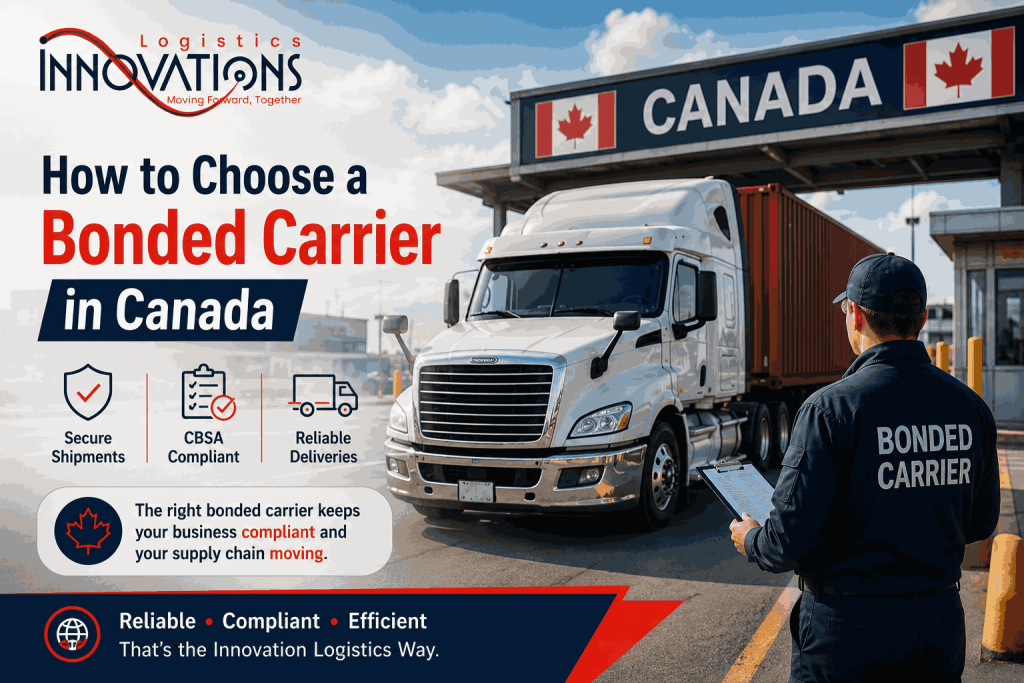
Moving freight across the Canadian border or across provinces requires absolute precision, strict regulatory compliance, and fast transit times. For businesses importing goods into Canada, standard freight transport is not always enough. When shipments need to move inland before customs release, or when goods travel through Canada to reach another destination, working with a bonded carrier in Canada becomes essential.
Choosing the right bonded freight carrier Canada provider protects your business from costly supply chain disruptions, unexpected customs holds, and unnecessary tax payments. This guide breaks down what bonded freight is, how the customs process works under the Canada Border Services Agency (CBSA), and the key factors every business should evaluate when selecting a bonded logistics partner.
What is a Bonded Carrier and How Does Bonded Freight Work?
To select the best partner, it helps to first understand what is a bonded carrier and what is bonded freight.
A bonded carrier is a carrier authorized by the Canada Border Services Agency (CBSA) to transport eligible in-bond goods under customs control. Bonded carriers must post the required financial security with the CBSA. For highway carriers, the security is $5,000 per vehicle, up to a maximum of $25,000.
The Core Advantage: Duty Deferral and Inland Movement
When a non-bonded highway carrier transports freight into Canada, shipments generally must be released at the First Port of Arrival (FPOA). However, in applicable circumstances, a non-bonded carrier can obtain a single-trip authorization to move goods beyond the FPOA.
In contrast, Bonded freight services can allow eligible commercial goods to move beyond the First Port of Arrival under customs control to an authorized inland destination, where the applicable customs process can be completed. The shipment travels under customs bond directly to an authorized inland location, such as a sufferance warehouse or an inland CBSA port, where final clearance occurs.
Key Benefits of Bonded Freight Services
- Customs-Controlled Inland Movement: Eligible goods can move beyond the FPOA under customs control when the shipment is destined for an inland customs location or other authorized movement.
- In-Transit Transportation: Eligible goods can move through Canada from one foreign point to another without being released for Canadian consumption, subject to the applicable CBSA in-transit requirements.
5 Critical Factors to Look For When Selecting a Bonded Freight Carrier in Canada
Selecting the right partner requires vetting their technical qualifications, regulatory compliance, and operational infrastructure. Here are five non-negotiable criteria every business should evaluate:
1. Verification of Active CBSA Bonded Status
Never assume a freight provider is bonded simply because it advertises cross-border transportation services. The Canada Border Services Agency (CBSA) assigns carriers a unique four-character carrier code, and carriers can have either bonded or non-bonded status.
Ask the provider for its current CBSA carrier code and confirm that it has the appropriate bonded status for the transportation service you require. For highway carriers, CBSA requires financial security for bonded operations of $5,000 per vehicle, up to a maximum of $25,000. The required customs bond must remain valid for the carrier to continue its bonded operations.
A carrier may have either a continuous bond or a bond for a specified period. If a specified-period bond expires, the associated bonded carrier code expires when the bond terminates.
2. Full Integration with CARM and ACI eManifest
Modern Canadian customs compliance depends on digital reporting systems. The CBSA enforces strict advance electronic reporting through the Advance Commercial Information (ACI) eManifest program. Additionally, importers and carriers must operate within the CBSA Assessment and Revenue Management (CARM) system.
A bonded carrier should have processes and systems in place to meet its applicable CBSA reporting obligations, including ACI/eManifest requirements for highway shipments. Ask how the carrier manages cargo data, reporting, corrections, and communication with your customs broker.
3. Access to Bonded Warehousing Networks
Transportation is only one part of the in-bond supply chain. Frequently, shipments arriving inland must be stored safely while awaiting customs documentation from brokers.
Inquire whether your carrier owns or partners with secure sufferance warehouses. Companies offering comprehensive bonded shipment services can seamlessly transition your freight from long-haul transport into CBSA-approved temporary storage, maintaining continuous regulatory control over your goods.
4. Specialized Equipment and Fleet Capabilities
Not all bonded freight carriers handle every type of cargo. Consider the specific requirements of your freight:
- Temperature-controlled reefer units for perishable food or pharmaceuticals.
- Specialized flatbeds or heavy-haul equipment for industrial machinery.
- High-security box trailers equipped with GPS tracking for high-value retail goods.
Ask whether the carrier uses its own fleet or qualified subcontractors. If subcontractors are involved, confirm who remains responsible for the shipment and applicable customs requirements, and how any transfer of liability is documented.
5. Proven Experience in Your Industry Sector
Navigating Canadian customs requirements requires practical experience with specific commodity classifications. A freight forwarder or motor carrier with experience in your industry will anticipate clearance bottlenecks, assist with proper cargo manifest descriptions, and work efficiently alongside your customs broker.
How In-Bond Freight Transit Works: Step-by-Step
Understanding the physical flow of bonded freight helps businesses plan inventory schedules and set accurate customer expectations.
- Pick-up and Manifesting: The carrier picks up cargo outside Canada (or at a port) and submits an ACI eManifest to the CBSA indicating in-bond status.
- Border Authorization: At the border, the driver presents the in-bond documentation (such as Form A8A). CBSA authorizes the vehicle to proceed inland without paying duties at the booth.
- Inland Transport: The carrier moves the freight directly to a designated sufferance warehouse or inland customs terminal.
- Broker Customs Clearance: Your customs broker submits formal entry paperwork to the CBSA to account for duties and taxes.
- Final Release and Delivery: Once the CBSA issues an electronic release, the goods are moved out of the warehouse and delivered to your final facility.
Cost Considerations When Hiring Bonded Freight Services
While working with bonded freight carriers offers financial flexibility through duty deferral, businesses should understand the associated cost structures:
Cost Element | Description | How to Manage It |
In-Bond Surcharge | A fee charged by carriers for administrative reporting and bond maintenance. | Compare all-in quotes that bundle eManifest filing and border paperwork fees. |
Sufferance Storage Fees | Fees charged by inland warehouses while waiting for customs brokers to release cargo. | Ensure all commercial invoices and entry documents are ready before freight reaches the border. |
Bonded Re-Delivery Charges | Costs incurred if cargo must be moved from an inland warehouse to the final site after clearance. | Partner with a single logistics provider that handles both in-bond transport and final distribution. |
Frequently Asked Questions
1: What is the difference between a bonded and non-bonded carrier in Canada?
A bonded carrier can transport eligible in-bond goods beyond the First Port of Arrival. A non-bonded carrier generally must have goods released at the FPOA unless an applicable procedure, such as a single-trip authorization, allows the goods to move inland.
2: How do I check if a freight carrier is bonded in Canada?
You can ask the carrier for its current four-character CBSA carrier code and confirm that it has bonded status appropriate for the transportation service you require.
3: Can a bonded carrier subcontract transportation to another carrier?
Some subcontracting arrangements are permitted, but the applicable CBSA reporting, documentation, and liability requirements must be followed. Businesses should ask who remains responsible for the goods while they are moving in bond.
4: How much financial security is required for a bonded highway carrier in Canada?
For Canadian highway carriers, the CBSA typically requires a customs bond or cash security ranging from $5,000 to $25,000, depending on the scope of operations and fleet size.
5: Why should my business choose in-bond transport instead of clearing cargo at the border?
In-bond transport prevents border delays caused by missing paperwork, defers payment of duties and taxes until goods reach an inland facility, and allows efficient transit through Canada for goods destined for other markets.
Partner with a Trusted Canadian Logistics Expert
Choosing the right bonded carrier in Canada is a strategic decision that directly impacts supply chain efficiency, cash flow, and regulatory compliance. By verifying CBSA carrier codes, confirming CARM integration, and ensuring access to bonded warehousing networks, businesses can streamline cross-border trade while reducing customs friction.
When managing cross-border inventory and customs-controlled freight, you need a logistics team that prioritizes transparency and compliance. Work with experienced specialists to keep your supply chain moving seamlessly across North America.